

Home / Field Notes — Land Clearing Knowledge Base / Summer Land Management in New Jersey: Maintaining Cleared Property and Preventing Regrowth
Summer Land Management in New Jersey: Maintaining Cleared Property and Preventing Regrowth
Published April 6, 2026 by Brush Busters • Last reviewed April 6, 2026
You cleared the property. The brush is gone, the mulch is down, and the land looks great. Now it’s July and you’re watching new growth push through the mulch layer. Small shoots of autumn olive. Multiflora rose sprouting from root fragments. A few knotweed stalks along the drainage. This isn’t failure — it’s expected. Every cleared property in New Jersey will see some regrowth in the first summer. What matters is how you manage it.
Summer is the season when cleared land either stays cleared or starts reverting. The decisions you make between June and September determine whether your clearing investment holds for years or gets lost within two growing seasons. Here’s the maintenance playbook.
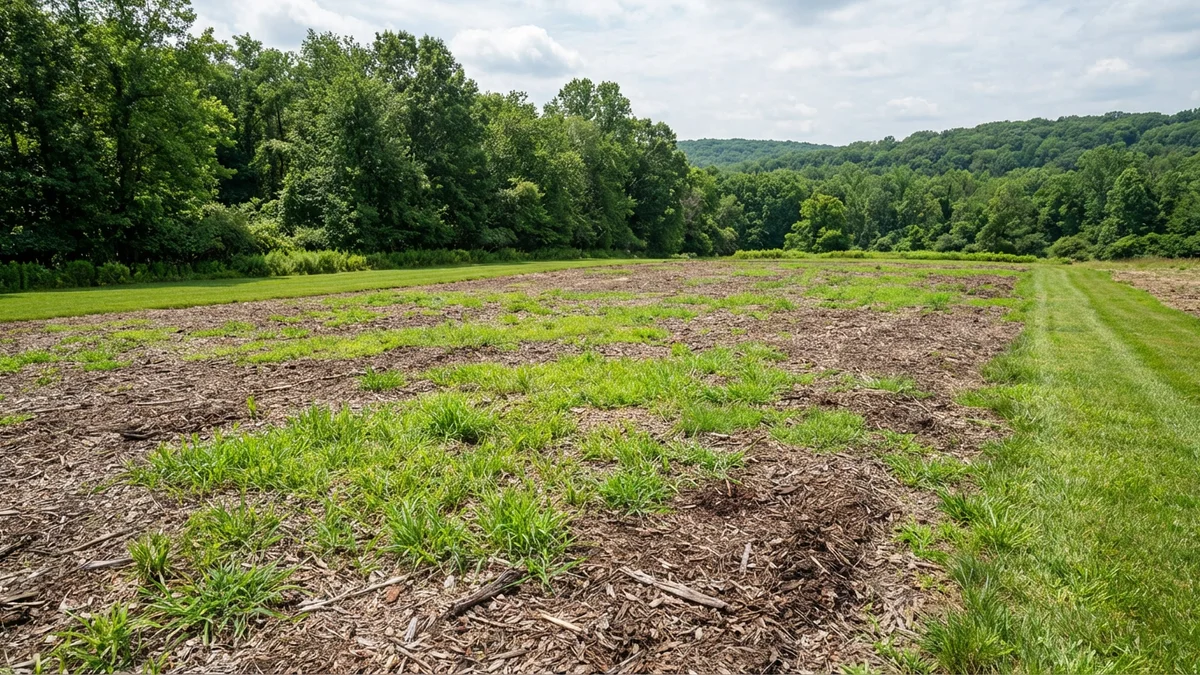
What's regrowing and why
Three sources of summer regrowth appear on cleared NJ properties:
Root resprouts. Invasive species with established root systems — multiflora rose, autumn olive, Japanese barberry, and tree of heaven — can send up new shoots from root fragments and root crowns that survived the mulching. These resprouts are typically smaller and weaker than the original plants. They’re also vulnerable: a single mowing pass or spot herbicide application eliminates most of them. The mulch layer slows and weakens resprouts by blocking light, but some species push through regardless.
Seed bank germination. Seeds deposited in the soil over years of invasive growth germinate when light reaches the surface. Mile-a-minute vine, autumn olive seedlings, Callery pear seedlings, and annual weeds all emerge from the seed bank. The mulch layer suppresses most germination, but on thinner mulch sections or at the edges of the cleared area, seedlings find their way through.
Native succession. Not all regrowth is bad. Native grasses, goldenrod, asters, and wildflowers also emerge through the mulch. On properties where the goal is a meadow or natural ground cover, this native regrowth is desirable. The challenge is distinguishing native succession (let it grow) from invasive regrowth (remove it).
The summer maintenance schedule
June: First inspection. Walk the cleared property and assess what’s regrowing. Identify the species. If you see root resprouts from tree of heaven, knotweed, or bittersweet — these need immediate treatment because they grow fastest. Flag areas where invasive resprouts are concentrated. Note any areas where the mulch is thin and seeding is heavier.
July: First maintenance mow or treatment. By mid-July, resprouts are large enough to mow but small enough that a single pass eliminates them. A standard brush mower or rotary mower handles first-year resprouts easily — the stems are soft and under an inch in diameter. On properties with targeted species (knotweed, tree of heaven), apply herbicide to the regrowth rather than mowing — these species need chemical treatment to kill the root system.
August: Herbicide window. Late summer is the optimal timing for herbicide application on perennial invasives. The plants are actively translocating sugars and nutrients from the leaves to the root system for winter storage, which carries the herbicide to the roots. Triclopyr or glyphosate applied to foliage in August-September is more effective at root kill than the same application in spring or early summer. A licensed applicator handles this.
September: Second mow or spot-treat. Any resprouts that emerged after the July mow get caught in a September pass. By September, annual weeds are setting seed — mowing before seed drop prevents the seed bank from replenishing. On properties being seeded for permanent ground cover, September is also an excellent seeding window in NJ. Cool-season grasses (fescue, ryegrass) establish well in the still-warm soil of early fall.
Managing the mulch layer
The forestry mulch on your cleared property is decomposing through the summer. This is normal and beneficial — the mulch is converting into organic matter that enriches the soil. Here’s what to expect:
Months 1–3 (first summer). The mulch darkens from fresh light brown to a deeper brown. It compacts slightly. Fungal activity is visible on the surface — white mycelial threads are common and indicate healthy decomposition. These fungi are breaking down the wood fiber and are completely harmless.
Months 4–6. The mulch is noticeably thinner as decomposition accelerates in summer heat. A layer that started at three to four inches may be down to two inches. The underlying soil is becoming visible in thin spots, particularly where equipment tracked during clearing.
Months 6–12. By the end of the first year, the mulch is largely integrated into the soil surface. What remains looks like rich, dark organic matter rather than distinct wood chips. The soil underneath is measurably improved — more organic content, better moisture retention, better structure.
Don’t add mulch. Property owners sometimes ask about adding landscape mulch to the decomposing forestry mulch. This is unnecessary and counterproductive. The forestry mulch is doing its job — decomposing into the soil. Adding landscape mulch on top creates an excessively deep layer that can become anaerobic and impede new plant establishment.
Summer clearing: when it makes sense
Summer isn’t the ideal season for NEW clearing projects, but it’s far from impossible. The ground is firm (dry summer conditions are better than wet spring), and the equipment operates normally. The downsides:
Foliage density. Full leaf-out means reduced visibility. The operator can’t see as far through the vegetation, which slows clearing speed on wooded properties.
Heat. Operator fatigue is real on long summer days. Work typically runs 7 AM to 3 PM in summer rather than the full-day production schedule possible in cooler seasons.
Regrowth risk. Clearing in June means the cleared area has the full summer growing season ahead of it. Any species that resprouts has maximum time to reestablish before the first frost. Summer clearing usually requires a fall maintenance mow that wouldn’t be needed with fall or winter clearing.
When summer clearing makes sense: deadline-driven projects (construction, pool installation, property closing), emergency situations (fire hazard, safety clearance, code compliance), and tick-habitat reduction where the homeowner wants relief during the active Lyme season.
Common Questions
How often should I mow cleared land in the first summer?
Two passes — July and September — handle most first-summer regrowth. Heavy knotweed or tree of heaven may need monthly attention. By year two, annual mowing is enough.
Is the white fungus on my mulch normal?
Completely normal and beneficial. It’s healthy fungi breaking down the mulch into soil organic matter. Harmless to people, pets, and plants. It disappears as the mulch dries.
When should I seed cleared ground?
September is ideal for cool-season grasses. Spring (April-May) is second-best. Summer seeding needs irrigation. Read our farm clearing guide for seeding details.
Will my cleared land grow back completely if I don't mow?
Without mowing, expect reversion within 3–5 years. One to two mowing passes per year prevents this completely. Annual maintenance is the cost of keeping land cleared.
Should I apply herbicide or just mow?
Mowing handles most species. Knotweed, tree of heaven, and bittersweet need herbicide. Rose, autumn olive, and barberry don’t survive repeated mowing. Learn about invasive management.
Can you clear land in summer?
Yes — firm ground and normal equipment operation. It’s slower due to foliage and heat, and may need a fall follow-up mow. It works when deadlines require it.
How do I tell invasive regrowth from desirable native plants?
Common invasive resprouts: autumn olive (silver leaves), rose (thorny), barberry (small leaves + thorns), tree of heaven (compound leaves, foul smell). Natives to keep: goldenrod, asters, native grasses. Unsure? Photo it and send to us.
What if I can't maintain the property myself?
We offer follow-up maintenance passes. First-year regrowth can also be handled with a standard brush mower. For larger or absentee-owned properties, we schedule 1–2 maintenance visits per summer. Ask about maintenance plans.
Want the full New Jersey land clearing playbook?
This article covers one piece of the puzzle. The complete guide ties together methods, costs, permits, terrain, and contractor selection in one place.
Cleared land only stays cleared if you manage it.
First-summer maintenance keeps your investment. We offer follow-up mowing and spot treatment.
Or call (908) 774-9235.