
Home / Field Notes — Land Clearing Knowledge Base / Tree Removal vs. Forestry Mulching: Which Do You Need?
Tree Removal vs. Forestry Mulching: Which Do You Need?
Published April 8, 2026 by Brush Busters • Last reviewed April 8, 2026
These two services get confused constantly. Property owners call us asking for “tree removal” when they actually need brush clearing. Arborists get calls about “mulching a field” that’s nowhere near their scope. The confusion costs people time and money — hiring the wrong service means either overpaying for a specialist you don’t need or getting a tool that can’t do the job.
Here’s the clear distinction: tree removal is taking down individual large trees using rigging, climbing, and directional felling techniques. Forestry mulching is clearing areas of brush, saplings, and small trees (up to about 8 inches in diameter) using a tracked machine that grinds everything at ground level. Different equipment, different skills, different price structures, different results.
When you need tree removal (arborist)
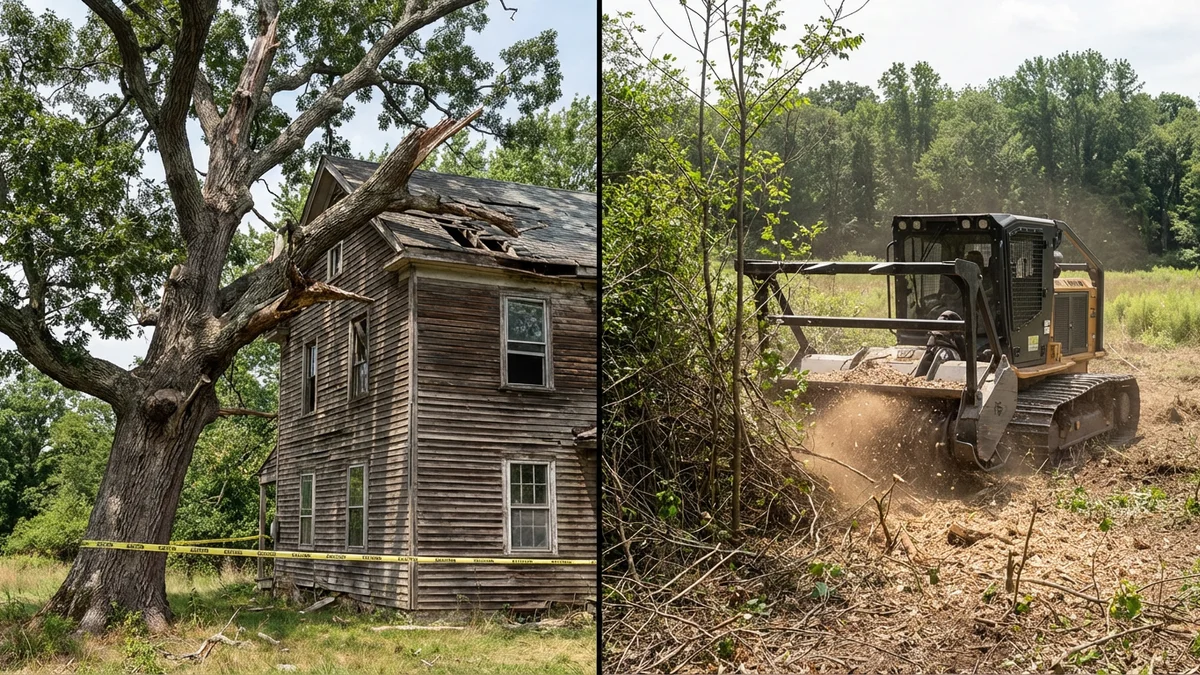
Large trees near structures. A 24-inch oak leaning toward your house requires an arborist with rigging equipment to control the fall direction. The forestry mulcher can’t handle trees this size, and even if it could, you wouldn’t want an uncontrolled fell near a building.
Individual hazard trees. A dead ash tree (thanks, emerald ash borer) standing 60 feet tall over your driveway. A cracked maple fork that could split in the next storm. A tree with root damage that’s leaning progressively. These are arborist jobs — they require assessment of the failure risk and controlled removal.
Trees in tight spaces. A large tree between two houses, over a pool, next to a utility line, or within reach of a fence. The arborist climbs, sections the tree from the top down, and lowers pieces with ropes. The mulcher can’t reach 40 feet up a trunk.
Stump removal below grade. If you need the stump ground out below the soil surface — for a patio, a foundation, a replanting — that’s a stump grinder (often provided by the arborist or a separate stump grinding service). Forestry mulching grinds to ground level but doesn’t excavate below.
Tree removal cost: $500 to $3,000+ per tree depending on size, location, and complexity. A large tree near a house with rigging requirements can exceed $5,000.
When you need forestry mulching
Area clearing. You’re not removing one tree — you’re clearing a half acre, an acre, five acres. The area is overgrown with brush, saplings, vines, and small trees. You want the whole area converted from impassable to usable in one to three days. This is forestry mulching territory.
Brush and understory. The property has a mature forest canopy you want to keep, but the understory is choked with barberry, multiflora rose, and vine growth. The mulcher clears the understory while preserving every canopy tree.
Small trees in volume. A fallow field with hundreds of autumn olive and red cedar saplings, each three to six inches in diameter. An arborist would charge per tree; a mulcher charges per acre. The economics are radically different at volume.
Fence lines, trails, and corridors. Linear clearing jobs — fence rows, trails, utility easements, driveways — where the mulcher works in a straight line at production speed.
Invasive species removal. Property-wide clearing of invasive vegetation where the goal is habitat modification, not individual tree management.
Forestry mulching cost: $1,200 to $4,000 per acre. Per-tree, this works out to $5 to $20 per small tree — compared to $500+ per tree for arborist removal.
When you need both
This is the most common scenario on wooded NJ properties. The property has a few large trees that need arborist removal AND a larger area of brush and understory that needs mulching.
The correct sequence: 1. Arborist removes the large hazard trees (the ones over 8-10 inches in diameter that need controlled felling) 2. Forestry mulcher comes in after and clears the brush, processes the arborist’s debris, and handles everything else at ground level
This sequence is more cost-effective than having the arborist handle everything (arborists charge per tree, not per acre) and more thorough than mulching alone (the mulcher can’t handle the big trees).
On storm damage projects, this two-step sequence is standard: arborist handles the hazardous situations on day one, mulcher processes the debris field on day two.
The comparison table
| Factor | Tree removal (arborist) | Forestry mulching |
|---|---|---|
| What it handles | Individual trees, any size | Brush, saplings, small trees ≤8″ |
| Pricing model | Per tree ($500–$5,000+) | Per acre ($1,200–$4,000) |
| Equipment | Chainsaws, rigging, crane, chipper | Tracked mulching machine |
| Debris | Hauled off-site or chipped on-site | Processed in place as mulch |
| Stump handling | Ground below grade (optional) | Ground to ground level |
| Soil impact | Minimal (hand work) | Minimal (surface only) |
| Speed on area clearing | Slow (tree by tree) | Fast (continuous pass) |
| Best for | Hazard trees, near structures, large diameter | Area clearing, brush, understory, invasives |
Common Questions
Can a forestry mulcher take down a large tree?
Up to about 8 inches in diameter. Larger trees need an arborist. On mixed properties, the arborist goes first, then the mulcher clears the rest.
Is forestry mulching cheaper than tree removal?
For area clearing, dramatically — per-acre pricing vs. per-tree. A field of 500 saplings costs $6,000–$15,000 to mulch vs. $250,000 at per-tree arborist rates.
Do I need an arborist or a mulcher for my property?
Large trees near structures → arborist. Overgrown area of brush → mulcher. Both → call us and we'll tell you the right sequence.
What happens to the stumps with forestry mulching?
Ground flush with the soil, covered by mulch. Not visible, not a trip hazard. If you need below-grade removal, a stump grinder handles that separately.
Can you handle storm debris or just standing vegetation?
Both — the mulcher processes fallen debris fields as well as standing vegetation. Read about our storm cleanup approach.
Do you work with arborists?
Yes — we coordinate scheduling with arborists. They handle the big trees, we follow immediately with the mulcher for everything else.
Can the mulcher preserve specific trees during clearing?
Yes — we clear within inches of flagged trees. Walk the site with us beforehand and we flag everything to preserve.
What size tree is the cutoff between mulcher and arborist?
Up to ~8 inches with the mulcher. 8–12 inches depends on species. Above 12 → arborist. We assess during the site visit.
Can you cut down a tree on your property in NJ?
In most NJ towns, yes – but many municipalities require permits for trees above 6-8 inches in diameter. Towns like Mendham, Bernardsville, and Bridgewater have specific tree ordinances. Properties in the Highlands Preservation Area face additional restrictions. Check with your municipal zoning office before removing trees.
How much does it cost to take down a tree in NJ?
$500-$3,000 per tree in NJ depending on size and complexity. Small trees (under 20 ft): $300-$800. Medium (20-40 ft): $500-$1,500. Large trees near structures: $3,000-$5,000+. For clearing multiple trees over a larger area, forestry mulching at $1,200-$4,000 per acre is significantly more cost-effective than per-tree removal.
How much is it usually to take down a 12 foot tree?
A 12-foot tree costs $200-$500 for individual removal. But if you have many small trees, forestry mulching handles hundreds per acre at $1,200-$4,000/acre – roughly $5-$20 per tree vs. $200-$500 each with an arborist.
Can I remove a tree myself?
Small trees (under 6″ diameter, under 20 ft) can be DIY with a chainsaw and safety gear. Anything larger, near structures, or near power lines needs a professional. For clearing multiple trees, a professional mulcher is faster, safer, and often cheaper than doing it yourself with hand tools.
What is the 5 15 90 rule tree felling?
The 5-15-90 rule is a tree felling safety guideline: stand 5 feet from the base after cutting, maintain a 15-degree retreat angle behind the fall direction, and stay out of the 90-degree danger zone on either side. This is a professional technique – homeowners should hire a certified arborist rather than attempt felling themselves.
Related Services
Forestry Mulching
We grind brush, saplings, and small trees into mulch on the spot – no hauling, no burn piles, no mess.
Want the full New Jersey land clearing playbook?
This article covers one piece of the puzzle. The complete guide ties together methods, costs, permits, terrain, and contractor selection in one place.
Not sure if you need an arborist or a mulcher?
We'll walk the property and tell you honestly. If you need an arborist first, we'll say so.
Or call (908) 774-9235.