

Home / Field Notes — Land Clearing Knowledge Base / How to Clear a Wooded Lot in New Jersey: Step by Step
How to Clear a Wooded Lot in New Jersey: Step by Step
Published April 8, 2026 by Brush Busters • Last reviewed April 8, 2026
You own a wooded lot. You want to use it — for a home, a barn, a garden, or just open space. Between you and that goal is a quarter acre to ten acres of trees, brush, vines, and invasive species that haven’t been managed in years — maybe decades. This guide walks you through the process from start to finish, in the order things need to happen.
Step 1: Know what you have
Before you clear anything, understand the lot. Walk it — or as far into it as you can — and note:
Terrain. Is it flat, sloped, or mixed? Slopes change the clearing method, cost, and what you can do with the land afterward. The Watchung ridge areas of Bridgewater and Bernardsville have steep basalt terrain. The Highlands towns have rocky ridgelines. The valley floors of Hunterdon and Warren counties are gentler.
Vegetation. Is it mostly brush and saplings (under 8 inches in diameter) or mature forest (trees over 12 inches)? This determines whether you need a forestry mulcher alone or an arborist first. Most wooded lots in NJ have a mix.
Water features and wet areas. Streams, drainage draws, seasonal wet spots, and potential wetlands all affect what you can clear, where you can build, and what permits you might need.
Existing features. Old stone walls, fence lines, wells, foundations, utility lines. These need to be preserved or accounted for during clearing.
Access. How does equipment get from the road to the lot? A flat front yard with a wide gate is easy. A narrow side yard between houses, a steep uphill driveway, or a quarter-mile of woods with no road — these require planning.
Step 2: Determine regulatory constraints
Before clearing, check:
Highlands Act. Is your lot in the Highlands Preservation Area or Planning Area? This affects what development (and associated clearing) is permitted and what review is required.
Wetlands. Are any portions of the lot mapped as wetlands? NJ DEP freshwater wetlands regulations restrict clearing within wetlands and their buffer zones (50–300 feet).
Municipal tree ordinances. Does your municipality regulate removal of trees above a certain diameter? Mendham, Bernardsville, Bridgewater, and others have tree ordinances that may require permits or replacement planting.
Zoning setbacks. If you’re clearing for construction, what are the required setback distances from property lines, road frontage, and other structures? This defines the maximum building envelope and therefore the minimum clearing area.
SESC requirements. Projects disturbing more than 5,000 square feet of soil require an erosion and sediment control plan. Forestry mulching may not trigger this because it doesn’t expose bare soil — but confirm with your Soil Conservation District.
Step 3: Get a survey
On any lot where construction will follow clearing, a boundary survey before clearing is the standard sequence — but clearing the boundary corridors first makes the survey faster and cheaper. The surveyor stakes property corners, identifies the building envelope, and establishes the baseline for setback measurements. Without a survey, the clearing crew doesn’t know where to stop.
On lots being cleared for non-construction purposes (pasture, recreation, trails), a survey may not be necessary if boundary markers are accessible or the clearing stays well inside the property boundaries.
Step 4: Call 811
Non-negotiable. Call 811 at least three business days before any clearing. Underground utilities get marked for free. Even on undeveloped wooded lots, there may be underground services running through the property — gas, water, electric, telecom, sewer. The machine operator needs to know where they run.
Step 5: Plan what stays and what goes
Walk the lot with the clearing crew. Flag every tree you want to preserve — for shade, screening, aesthetics, or municipal ordinance compliance. Identify the clearing boundary (how far to clear from the edges). Decide on the clearing method for the different zones:
Full clearing zones (building pad, driveway, septic field): everything goes to ground level.
Selective clearing zones (wooded borders, screening buffers): understory and invasives cleared, canopy trees preserved.
No-touch zones (wetland buffers, neighbor boundaries, protected areas): the machine stays out entirely.
This walk-through takes 30 minutes and prevents misunderstandings during execution.
Step 6: Clear
For most NJ wooded lots, the clearing sequence is:
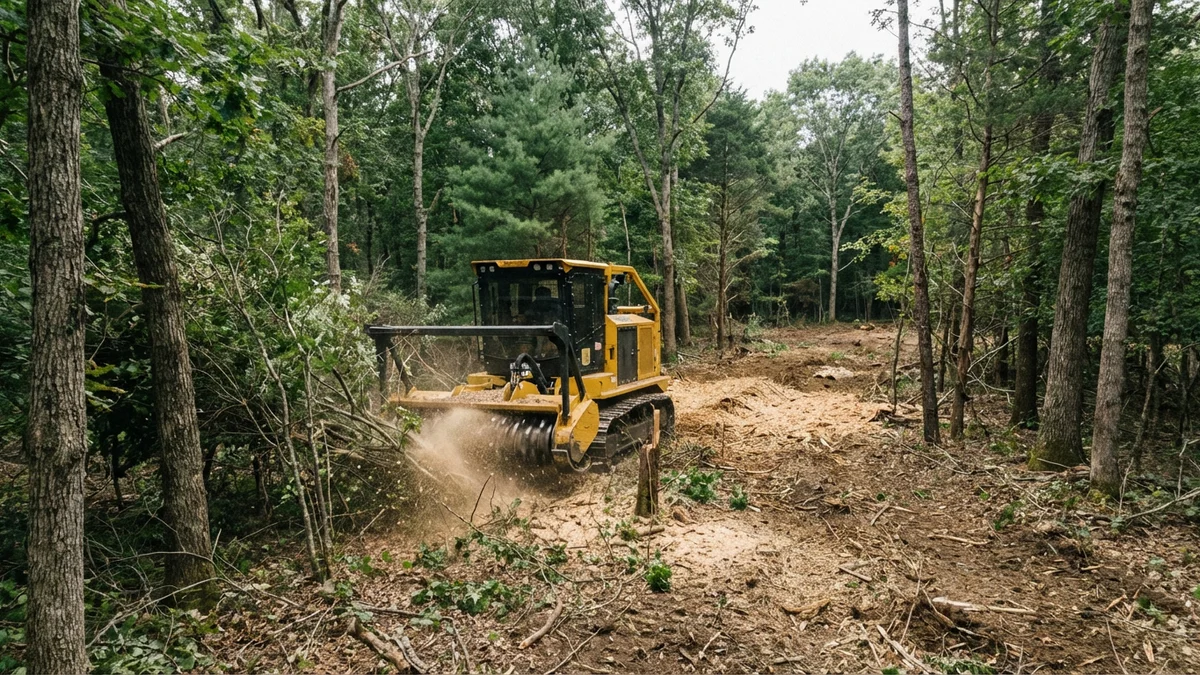
1. Arborist removes any trees over ~8–10 inches that are in the full clearing zone and need controlled felling (near structures, property lines, or other trees to preserve). 2. Forestry mulcher clears everything else — brush, saplings, small trees, vine growth, invasive species. The machine works zone by zone, starting from the access point and working inward. 3. The mulch layer covers the cleared ground. No debris hauling, no brush piles, no burn permits.
Timeline: a typical one-to-two-acre lot clearing takes one to three days with the mulcher. Add a day for arborist work if large trees are involved.
Step 7: Assess the cleared ground
Once the lot is cleared, you see the land for the first time. Walk it again. Note:
– Rock near the surface (affects excavation for foundations and septic) – Wet areas or drainage patterns (affects building placement and grading) – Grade changes and slopes (affects site design) – Soil conditions (affects septic, planting, and foundation decisions)
Share these observations with your builder, engineer, or designer. The cleared lot is the canvas they’ll design on — and what they see now determines the plan.
Step 8: Protect the site
If construction doesn’t begin immediately, the mulch layer protects the cleared lot from erosion and regrowth. No additional measures needed on flat to moderate terrain. On steep slopes, install silt fence along the downhill perimeter.
If the gap between clearing and use extends past one growing season, schedule a maintenance mow during the summer to prevent invasive regrowth from re-establishing.
Costs for wooded lot clearing
| Lot type | Typical size | Cost range |
|---|---|---|
| Suburban wooded lot | 0.5–1 acre | $2,500–$6,000 |
| Rural wooded lot | 1–3 acres | $4,000–$12,000 |
| Large rural parcel (selective) | 3–10 acres | $8,000–$25,000 |
| Arborist for large trees (if needed) | per tree | $500–$3,000+ |
These are clearing-only costs. They don’t include survey, permits, grading, or construction.
Common Questions
How much does it cost to clear a wooded lot in NJ?
Suburban lot: $2,500–$6,000. Rural lot: $4,000–$12,000. Larger parcels: $8,000–$25,000. Get a free estimate for your lot.
How long does it take to clear a wooded lot?
1–3 days for a typical 1–2 acre lot. Dense vegetation or arborist work adds time. We provide specific timelines with every quote.
Do I need to clear the whole lot?
Usually no — most projects clear portions while preserving surrounding woods. Selective clearing opens what you need and preserves what you value.
What should I do first — survey or clear?
Clear boundary corridors, then survey. Surveyors work faster on cleared ground. Read about clearing for surveyors.
Can I clear the lot myself?
Small patches: feasible with hand tools. Over a quarter acre: professional equipment is necessary and often costs less than rental when you factor in time and results.
What happens to the wood from cleared trees?
Small trees → mulch on-site. Large trees → firewood rounds (kept or hauled). Tell the arborist if you want the firewood.
Do I need permits to clear a wooded lot?
Brush: typically no permit. Large trees: check your tree ordinance. Highlands/wetlands: check with NJ DEP and zoning. Read our permits guide.
What if I don't have an immediate use for the cleared lot?
The mulch protects the lot for 6–12 months. One maintenance mow in the first summer prevents regrowth. Decide on use at your own pace.
What can a homeowner do without a permit in NJ?
In NJ, homeowners can clear brush, saplings, and small trees without a permit in most municipalities. Permits may be needed for large trees (check your municipal tree ordinance), clearing in the Highlands Preservation Area, work near wetlands, or projects disturbing 5,000+ sq ft of soil. Check with your local zoning office.
Related Services
Land Clearing / Lot Prep
Residential and small commercial lots cleared and prepped for building, grading, or landscaping.
Want the full New Jersey land clearing playbook?
This article covers one piece of the puzzle. The complete guide ties together methods, costs, permits, terrain, and contractor selection in one place.
Got a wooded lot? We clear the path to what's next.
Survey coordination, selective preservation, fixed pricing. Free site visit.
Or call (908) 774-9235.