
Home / Field Notes — Land Clearing Knowledge Base / Forestry Mulching vs. Bulldozing: Which Is Right for Your NJ Property?
Forestry Mulching vs. Bulldozing: Which Is Right for Your NJ Property?
Published March 20, 2026 by Brush Busters • Last reviewed March 20, 2026
If you own an overgrown property in New Jersey, you have probably heard two very different terms thrown around for the same basic problem: forestry mulching and bulldozing. On the surface, both sound like they clear land. That part is true. The difference is how they clear it, what the property looks like afterward, and how much extra work you create for yourself once the first machine leaves.
For most residential and small-acreage jobs in New Jersey, these methods are not interchangeable. One is built to grind vegetation in place and leave a usable finish. The other is built to push, strip, reshape, and move material. If your real problem is brush, saplings, invasive growth, and tight New Jersey terrain, the method you choose can change your price, your timeline, and how much cleanup you are still staring at when the work is done.
What forestry mulching actually does
Forestry mulching is a vegetation-clearing method. A tracked machine with a mulching head grinds brush, vines, saplings, and many small trees directly where they stand. Instead of cutting everything, piling it, and trucking it out, the machine processes it into a mulch layer that stays on the site.
That matters on a lot of New Jersey properties. Many local jobs are not wide-open construction sites. They are half-acre backyards in Bergen County, wooded side lots in Morris County, steep sections in Sussex County, or brushy property edges where access is tight and the ground is uneven. In those settings, mulching is often the cleaner tool because it does not need as much room to stage piles or drag material around.
The finished look is one of the biggest reasons homeowners and smaller landowners choose it. When the job is done, the site is typically open, walkable, and covered with a natural layer of processed mulch. You are not left with rows of brush waiting for a second crew. You are not stuck figuring out whether you need a burn permit, a dumpster, or a hauling contractor.
What bulldozing actually does
Bulldozing is different from the start. A dozer is meant to push, strip, and reshape. That can be exactly what a site needs if the goal is full construction prep, major grading, road building, or deep earthmoving. A bulldozer is strong, aggressive, and useful when the plan goes beyond clearing vegetation and into changing the ground itself.
That same strength is why it can be the wrong tool for a residential clearing job. If your property is mostly covered in brush, thorny undergrowth, vines, and small trees, a dozer often turns a vegetation problem into a soil problem. It pushes organic material into piles, exposes bare dirt, and leaves more finish work behind. In many cases, it also creates a second phase: somebody still has to deal with all the piles.
For some builders, a dozer is part of the larger site package. If the job is already moving toward excavation and grading, then bulldozing may be built into the sequence. But that does not mean it is automatically the smartest first step for every property owner dealing with overgrowth.
The biggest difference is what happens after the first pass
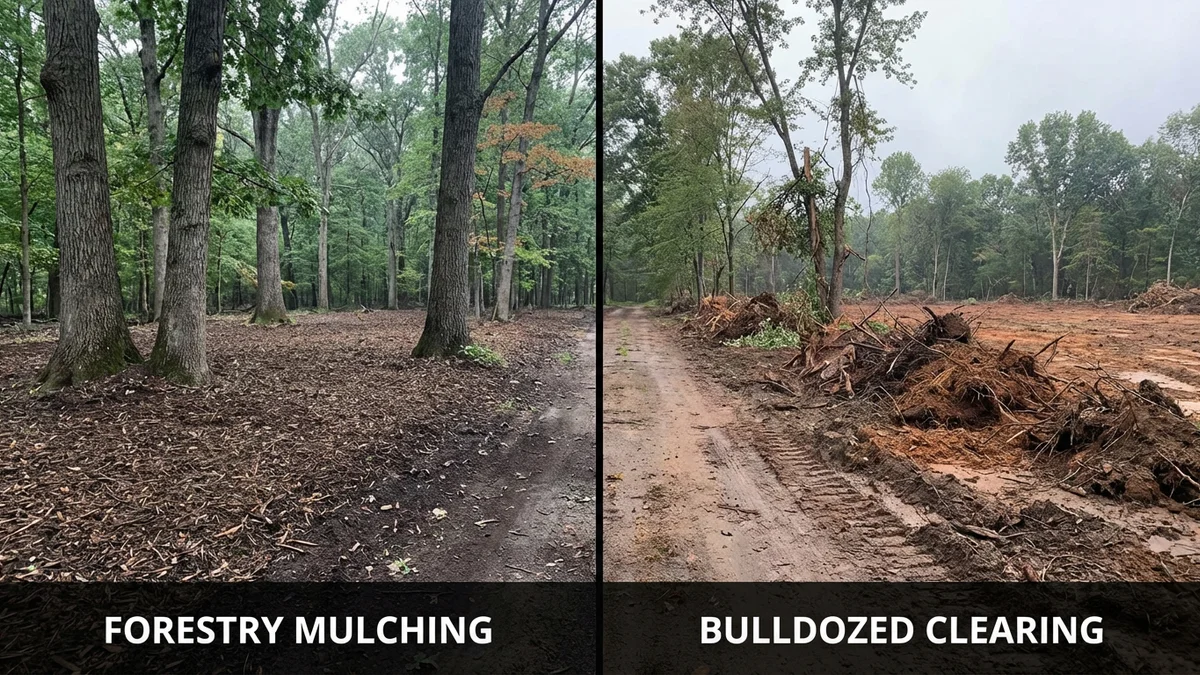
The easiest way to understand the difference is to picture the site after each method. After forestry mulching, the ground is usually open and covered with chopped organic material. The mulch helps protect the soil surface, softens the look of the site, and makes it easier to maintain the area after clearing. Many homeowners are surprised that a heavily overgrown lot can look finished the same day the clearing happens.
After bulldozing, the site often looks rougher. The machine may get vegetation down quickly, but now the material has to go somewhere. That can mean piles of brush and roots, scraped dirt, rutting, and more visible disturbance. If the site is headed straight into mass excavation, that may be acceptable. If you just wanted your backyard, fence line, or wooded edge opened back up, it is often more disruption than you needed.
This is why land clearing and heavy site prep are not always the same conversation as simple vegetation control. The finish matters. The next trade matters. The owner’s goal matters. Clearing land for access, appearance, and usability is different from clearing land for a full building pad.
Cost is not just the machine rate
People often ask which method is cheaper. That is a fair question, but the answer depends on what you include in the math. Forestry mulching usually looks strong on price because it combines cutting and debris processing into one operation. There is no separate bill for hauling piles away. There is no added cleanup crew to stack, burn, or truck material out. On many residential properties, that one-pass efficiency is what keeps the number in a practical range.
Bulldozing can look competitive if you compare only the first day of machine time. But that comparison misses what happens next. If the dozer leaves brush piles, root balls, and loose debris, you still have to pay to deal with those. If the site needs erosion control or extra grading because the soil got torn up, those costs count too. A low first number can turn into a more expensive total project once the follow-up work starts.
New Jersey terrain pushes this even further. Rocky ground, narrow access, wet areas, and steep side slopes all affect how productive each machine can be. A mulcher on tracks is often better suited to controlled work on rough residential terrain than a dozer that needs more room to push and stack material. That is one reason the cheaper method on paper is not always the cheaper method at the end of the job.
Soil disturbance is where the methods really split apart
For a lot of New Jersey properties, preserving the ground matters just as much as removing the vegetation. Maybe the property sits above a stream corridor. Maybe the rear yard drops off toward a wet area. Maybe the lot is on a slope where exposed soil will wash hard in the next storm. Maybe you simply do not want to tear the place up more than necessary.
Forestry mulching is usually better for those situations because it leaves the topsoil more intact. The machine cuts vegetation down and leaves organic material on the surface. That mulch layer helps reduce rain splash, keeps bare dirt to a minimum, and slows erosion on slopes. On hillside properties in places like Morris County or the higher ground in Sussex County, that finish can be a major advantage.
Bulldozing, by comparison, is far more likely to disturb soil structure. That is not a knock on the machine. It is just the nature of what it is built to do. Once the blade starts pushing, you are moving more than vegetation. You are affecting grade, organic matter, and the surface layer that keeps the property stable. If the final goal needs that kind of work, fine. If it does not, you may be paying for damage you never wanted.
Time and access matter more in New Jersey than people think
Many New Jersey jobs are not on flat, empty land. They are behind houses, between tree lines, along long driveways, or on odd-shaped parcels where the equipment has to work carefully around what stays. In those conditions, forestry mulching usually fits better because it can clear selectively without needing wide turning room for piles and push lanes.
That selective control is a big reason mulching works so well on backyard projects, fence rows, and residential edges. If you want brush gone but mature trees kept, the operator can work right around the trees you want to save. If you want a trail opened up or a slope thinned out without flattening the whole thing, mulching gives you that kind of precision.
Bulldozing is less forgiving. It shines when the site is open enough for broad pushes and the job is meant to be rough first and refined later. It is not usually the better answer for the homeowner whose main complaint is, “I cannot even walk this property anymore.”
When bulldozing does make sense
There are times when a bulldozer is absolutely the right tool. If a site needs major regrading, deep stump removal, road building, mass fill movement, or broad excavation support, mulching alone is not enough. If you are building a new home, changing elevations, or creating a pad that requires earthwork, then a dozer may be part of the process.
The key is not pretending that one machine should do the entire job when the scope clearly calls for more. A site can be mulched first to open access and reduce vegetation volume, then turned over to excavation and grading crews afterward. On some projects, that sequence is smarter than leading with a dozer because it gives the whole team a cleaner site to work on.
That is why a good site visit matters. The question is not “Which machine is stronger?” The question is “What does this property actually need next?”
Why forestry mulching wins for most residential NJ jobs
For most residential properties in New Jersey, the real need is not earthmoving. It is reclaiming usable ground. The owner wants to see the back lot line again. The fence needs to come back into view. The brush and invasive growth need to go. The slope needs to be manageable. The site needs to look clean without creating a second problem in the form of piles and exposed soil.
That is where forestry mulching keeps winning. It is efficient, selective, and better suited to the kinds of parcels common in Bergen, Morris, Passaic, and Sussex counties. It handles the overgrowth that swallows suburban side yards and semi-rural acreage without turning the property into a construction zone.
It also fits how many owners want the project to feel when it is over. They want a clear result and a clear finish. They do not want three contractors in sequence just to reclaim a section of land that has gotten out of hand.
How to decide on your property
Start with the goal. If you want vegetation cleared, access reopened, views restored, or a parcel brought back under control, mulching is usually the better answer. If you need the ground stripped, moved, and reshaped for a deeper construction objective, then bulldozing may be part of the plan.
The second question is what you want the property to look like afterward. If you want a natural-looking finish with less disturbance, mulching has the advantage. If you are comfortable with exposed soil because the site is moving directly into excavation, then the extra disturbance may not matter.
The third question is whether the site can handle unnecessary disruption. On wet ground, slopes, stream edges, and tight residential lots, the cleaner method is often the smarter method. That is especially true in New Jersey, where a lot of properties are not forgiving once the ground gets opened up.
The bottom line
Bulldozing has its place. It is just not the best answer to every overgrown property. For most residential and light-commercial brush clearing jobs in New Jersey, forestry mulching gives you a faster, cleaner result with less hauling, less exposed soil, and a finish that actually looks usable when the machine leaves.
If you are trying to decide between the two, it helps to step back from the machine names and focus on the end result. What needs to disappear? What needs to stay? What does the site need to be ready for next? Once those answers are clear, the right method usually becomes obvious.
Common Questions
Is forestry mulching cheaper than bulldozing in New Jersey?
Usually, yes. Forestry mulching often costs less on residential brush-clearing jobs because there is no separate piling, hauling, or burn-pile cleanup.
When is bulldozing the better option?
Bulldozing makes more sense when a site needs heavy earthmoving, stump removal, mass grading, or full excavation for construction.
Does forestry mulching remove stumps?
No. Forestry mulching cuts and grinds vegetation at or near ground level, but it is not the same as stump excavation or full root removal.
Will bulldozing leave a cleaner site?
Not usually for residential clearing. Bulldozing often leaves disturbed soil, pushed piles, and follow-up cleanup, while mulching usually leaves a more finished-looking surface.
Is forestry mulching better for slopes?
In many cases, yes. Mulching is often a better fit for steep New Jersey slopes because it causes less disturbance and leaves a protective mulch layer behind.
Can forestry mulching handle small trees?
Yes. Commercial mulchers can usually process brush, saplings, and many trees up to about 6 to 8 inches, depending on species and site conditions.
Does bulldozing damage topsoil?
It can. Bulldozers are built to push and move material, so they often scrape, displace, or compact topsoil more than mulching does.
Can I build after forestry mulching?
Yes, but mulching is usually the clearing phase, not the final construction prep. If you are building, you may still need excavation, grading, staking, and utility coordination afterward.
Which method is faster for an overgrown backyard?
Forestry mulching is usually faster for an overgrown backyard because it clears and finishes in one pass without needing debris hauled away.
How do I know which method my property needs?
The best answer comes from the end goal. If you mainly need brush and saplings cleared, mulching is usually the better fit. If you need the entire site reshaped, bulldozing may be part of the plan.
Related Services
Forestry Mulching
We grind brush, saplings, and small trees into mulch on the spot – no hauling, no burn piles, no mess.
Land Clearing / Lot Prep
Residential and small commercial lots cleared and prepped for building, grading, or landscaping.
Brush Clearing
Thick undergrowth, vines, and overgrown fence lines cleared down to clean, walkable ground.
Relevant City Pages
These city pages are a good fit if you want to compare the article advice with the kind of properties we see on the ground.
Related Articles
Land Clearing Cost Per Acre in New Jersey: Pricing Guide
New Jersey land clearing cost per acre explained: method, terrain, tree size, access, and how to compare quotes without getting burned.
See Land Clearing Cost Per Acre in New Jersey: Pricing Guide
Japanese Knotweed Removal in New Jersey: How to Actually Kill It
How to remove Japanese knotweed in New Jersey: identification, why it spreads, why cutting fails, and how mulching plus follow-up treatment works.
See Japanese Knotweed Removal in New Jersey: How to Actually Kill It
Do You Need Permits for Land Clearing in New Jersey?
Do you need a permit to clear land in New Jersey? Learn when tree ordinances, wetlands, and the Highlands Act can affect your project.
Want the full New Jersey land clearing playbook?
This article covers one piece of the puzzle. The complete guide ties together methods, costs, permits, terrain, and contractor selection in one place.
Want Help Sorting Out the Next Step?
If the article answered part of the question but you still need a site-specific answer, send us the address and a few photos.
Or call (908) 774-9235.