
Home / Field Notes — Land Clearing Knowledge Base / Do You Need Permits for Land Clearing in New Jersey?
Do You Need Permits for Land Clearing in New Jersey?
Published March 17, 2026 by Brush Busters • Last reviewed March 17, 2026
One of the most common questions we get is also one of the hardest to answer with a simple yes or no: do you need a permit to clear land in New Jersey? Sometimes the answer is no. Sometimes the answer is absolutely yes. And a lot of the time, the real answer is, “It depends on what is on the property, where the property is, and how aggressive the clearing is.”
That is not contractors being vague. That is just how New Jersey works. Local tree rules can apply in one town and not the next. Wetland transition areas can affect a backyard that does not even look wet most of the year. Highlands restrictions can apply in one part of a county but not another. If you treat every lot like it follows the same rules, you are taking a gamble you do not need to take.
Start with the right question
The better question is not “Do permits exist?” The better question is “What kinds of rules might affect this specific clearing job?” That framing gets you much closer to the truth.
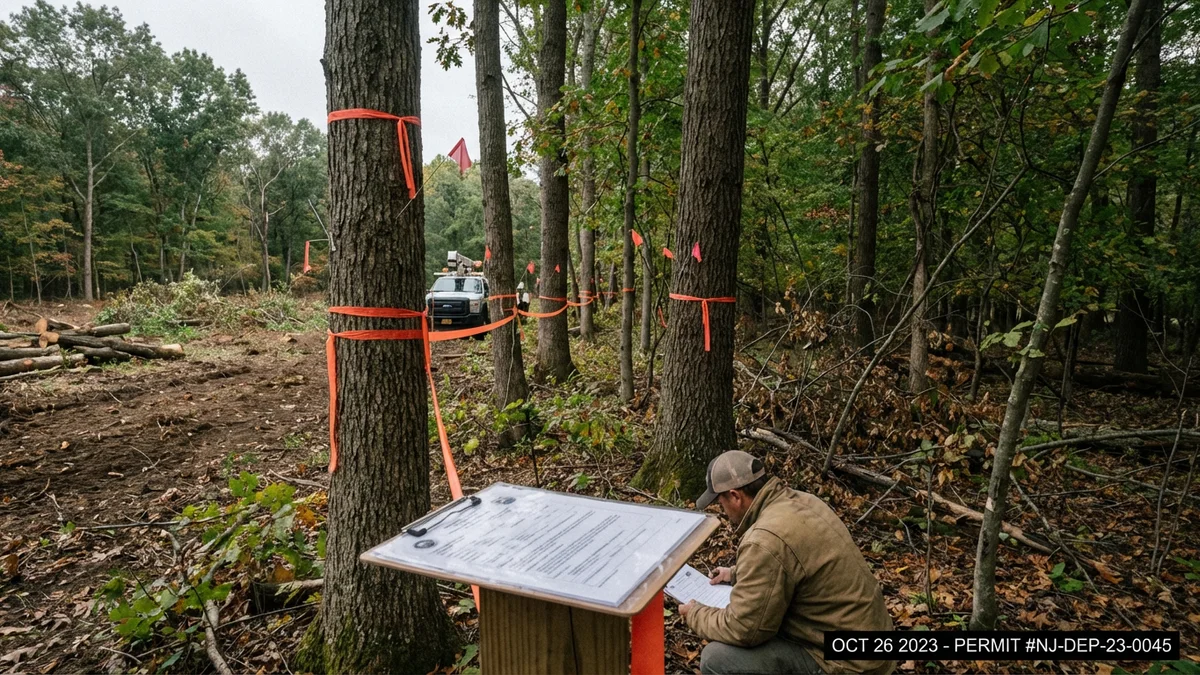
A routine brush clearing job on previously maintained upland ground may not trigger any state-level review at all. But that same clearing scope can become more complicated if the site sits near a wetland, inside a regulated buffer, or in a municipality with a strict tree ordinance. A job that looks ordinary from the driveway can involve very different rules once you know what is in the back of the property.
That is why we talk through both the goal and the site. “I want this brush gone” is not enough information by itself. We need to know where it is, what is growing there, and what the ground is connected to.
Municipal tree ordinances are often the first thing that trips people up
For many New Jersey property owners, the first real permit issue is not the state. It is the town. Municipal tree ordinances are common, and they vary more than most owners realize. Some towns regulate removal by trunk diameter. Some focus on street trees or trees in front-yard setbacks. Some require replacement plantings or fees. Some barely apply to brush and saplings at all.
This is why two neighbors in two different towns can get very different answers to what sounds like the same question. A suburban lot in one Bergen County municipality may involve far stricter tree review than a rural parcel in Sussex County, even if both owners say they are “just clearing some overgrowth.”
If you are dealing with anything more than light brush, it is smart to call the local zoning or construction office before work starts. Ask whether the town has a tree removal ordinance and whether your project triggers it. That one phone call can save a lot of aggravation.
Wetlands and transition areas are the bigger state issue
At the state level, freshwater wetlands and their transition areas are where permit questions get serious. New Jersey’s Freshwater Wetlands Protection Act regulates work in wetlands and in certain protective buffers around them. Those buffers are called transition areas.
The important part for owners is this: you do not have to be standing in a swamp for wetland rules to matter. A property can have a mapped wetland edge, drainage corridor, or regulated buffer that reaches into what looks like ordinary yard or woodland. The law also treats the transition area itself as protected ground, which means activities like soil disturbance, filling, structures, paving, and vegetation destruction may be restricted without an approved waiver or permit path.
The state’s own framework sets transition-area widths based on wetland resource value. In practical terms, that can mean buffers commonly ranging from 25 to 50 feet on some wetlands and 75 to 150 feet on higher-value wetlands. That is a big enough distance to matter on many residential lots.
How to check for wetlands before you make a mistake
The first step is usually mapping. NJDEP’s GeoWeb tools are useful for a first look, especially when you are trying to see whether the property appears close to mapped wetlands, streams, flood-prone areas, or Highlands boundaries. That kind of map check is not the same thing as a formal determination, but it is a smart place to begin.
If the site looks questionable, the next step may involve professional review or a formal state process such as a Letter of Interpretation. The point is not that every property needs one. The point is that if the mapping raises a flag, you should not assume the answer based on appearances alone.
This comes up a lot on wooded New Jersey lots where the back half of the property drops toward a swale or creek. Owners see brush and saplings. The map may see a regulated corridor. That difference matters.
The Highlands Act is a real issue in parts of New Jersey
The Highlands Act is another major reason permit questions get complicated, especially in western and northwestern parts of the region. The Highlands area spans parts of seven counties, and the Preservation Area has its own review structure for certain kinds of development and land disturbance.
For owners in places like Morris County, Passaic, Sussex, Warren, Hunterdon, or parts of Somerset, it is worth checking whether the property falls inside the Highlands Preservation Area before assuming a clearing project is routine. Not every brush job turns into a Highlands application, but the location can absolutely change the rules.
This is one reason western Morris County jobs often need a more careful early review than similar-looking jobs farther east. The town may matter. The mapped area may matter. The end use may matter. That is why blanket advice is dangerous.
Routine clearing versus development clearing
Another important distinction is whether the work is routine maintenance or part of a bigger development step. If you are simply trying to reopen an overgrown area on an existing property, the permit picture is often lighter than it is for work tied to a new build, driveway expansion, subdivision activity, or major site change.
Once the clearing becomes part of a development sequence, more rules can come into play. That is especially true if the project involves soil disturbance, grading, new impervious coverage, utility work, or construction in environmentally sensitive areas. A land clearing project for a future build should always be treated differently from basic property maintenance.
This is also why a contractor may ask what comes next after the clearing. The next phase tells us a lot about what approvals may matter now.
Calling 811 matters, but it is not a permit
One common point of confusion is utility marking. If a clearing project may involve ground disturbance, calling 811 matters. It is the right move before digging, excavation, or work near buried utilities. But 811 is not permit approval. It is a safety and utility-location step.
That distinction matters because some owners call 811, see flags show up, and assume that means they are fully cleared to proceed. It does not. You can need utility marking and still need a local or state approval for the work itself.
A solid project plan handles both sides: safety around infrastructure and compliance with whatever rules govern the site.
County examples help show how different this can be
In more suburban counties, permit questions often start with local ordinances, neighbor visibility, and lot-line constraints. In more rural counties, the pressure may come from Highlands overlap, wetland edges, stream corridors, or preserved land considerations. That is why “Do I need a permit?” can never be answered responsibly without location.
An overgrown residential lot in eastern Morris County may mostly be a municipal question. A wooded property in western Morris or Sussex may raise Highlands issues right away. A stream-edge clearing in Passaic may push wetlands concerns to the front even if the owner assumed it was just brush. The same machine can do the clearing in all of those places. The legal path to that clearing is what changes.
The safest process for owners
If you want the practical version, here it is. First, define the scope honestly. Are you clearing brush, removing bigger trees, prepping for construction, or opening a wet back lot? Second, check the municipality for tree rules. Third, review the site for wetlands, stream buffers, and Highlands overlap. Fourth, call 811 if the work involves disturbance where utilities matter.
Then bring in the contractor. A good contractor can look at the property and flag the obvious issues before you spend money in the wrong order. We do that all the time. But the municipality and the state are still the authorities that decide permit requirements. The contractor’s job is to help you avoid getting surprised.
The bottom line
Not every land clearing job in New Jersey needs a permit. But enough of them do that guessing is a bad plan. Local tree ordinances, wetlands, transition areas, and Highlands rules are the big issues to watch in New Jersey. The good news is that most of the risk can be reduced early with the right questions and a little upfront checking.
If you are not sure what applies to your property, start with the location and the scope. Once those are clear, the permit picture usually gets a lot easier to sort out.
Common Questions
Do all land clearing jobs in New Jersey need a permit?
No. Many routine clearing jobs do not require a state permit, but local tree ordinances, wetlands rules, and Highlands restrictions can still apply depending on the property.
Do towns in New Jersey regulate tree removal?
Many do. Municipal tree ordinances vary a lot from town to town, especially in New Jersey suburbs.
What is a wetland transition area?
A transition area is the protective buffer next to certain freshwater wetlands where clearing and disturbance may be limited or regulated.
Does the Highlands Act affect private property clearing?
Yes, in parts of the Highlands Preservation Area. Some projects may face additional review depending on location and scope.
How can I check if my property is near wetlands?
NJDEP mapping tools like GeoWeb are a good starting point, but some properties need formal review beyond a map check.
Can I clear brush without a permit if I am not removing big trees?
Sometimes, yes, but it still depends on the municipality and whether regulated environmental features are on the property.
Is calling 811 the same as getting a permit?
No. Calling 811 is about utility marking. It is important, but it does not replace local or state approvals.
Do wetlands rules only matter if the ground is obviously wet?
No. Wetland-related restrictions can apply even when the area is not visibly wet year-round.
Can a contractor tell me if I definitely need a permit?
A good contractor can flag common issues, but final permit authority usually sits with your municipality or the relevant state agency.
What is the safest first step before clearing land?
Check the municipality, review the site for wetlands or Highlands overlap, and make sure the clearing plan matches the actual conditions on the property.
Related Services
Land Clearing / Lot Prep
Residential and small commercial lots cleared and prepped for building, grading, or landscaping.
Forestry Mulching
We grind brush, saplings, and small trees into mulch on the spot – no hauling, no burn piles, no mess.
Brush Clearing
Thick undergrowth, vines, and overgrown fence lines cleared down to clean, walkable ground.
Relevant City Pages
These city pages are a good fit if you want to compare the article advice with the kind of properties we see on the ground.
Related Articles
Forestry Mulching vs. Bulldozing: Which Is Right for Your NJ Property?
Forestry mulching vs. bulldozing for NJ properties: compare cost, speed, soil impact, and when each method makes sense.
See Forestry Mulching vs. Bulldozing: Which Is Right for Your NJ Property?
Land Clearing Cost Per Acre in New Jersey: Pricing Guide
New Jersey land clearing cost per acre explained: method, terrain, tree size, access, and how to compare quotes without getting burned.
See Land Clearing Cost Per Acre in New Jersey: Pricing Guide
Japanese Knotweed Removal in New Jersey: How to Actually Kill It
How to remove Japanese knotweed in New Jersey: identification, why it spreads, why cutting fails, and how mulching plus follow-up treatment works.
See Japanese Knotweed Removal in New Jersey: How to Actually Kill It
Want the full New Jersey land clearing playbook?
This article covers one piece of the puzzle. The complete guide ties together methods, costs, permits, terrain, and contractor selection in one place.
Want Help Sorting Out the Next Step?
If the article answered part of the question but you still need a site-specific answer, send us the address and a few photos.
Or call (908) 774-9235.