

Home / Field Notes — Land Clearing Knowledge Base / Multiflora Rose Removal in New Jersey
Multiflora Rose Removal in New Jersey
Published March 14, 2026 by Brush Busters • Last reviewed March 14, 2026
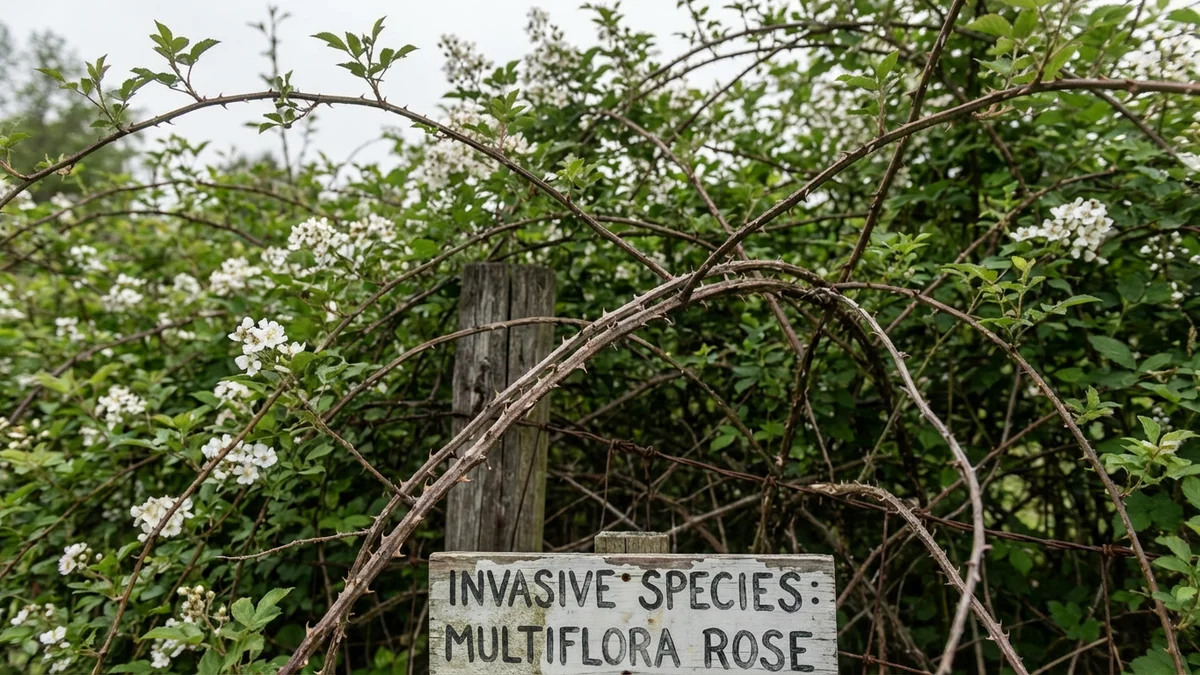
If Japanese knotweed is one of New Jersey’s worst invasive plants along water and disturbed ground, multiflora rose is one of the worst along fence lines, field edges, and old pasture margins. It is the plant that turns a property edge into barbed wire made of wood. Owners usually do not call it by name at first. They call it “that thorny stuff” or “the wall of rose bushes” that has swallowed the fence and keeps getting deeper every year.
That description fits because multiflora rose rarely stays neat. It spreads outward and upward, ties into itself, catches debris, and turns a simple boundary into an inaccessible mass. It is one of the most common reasons owners lose usable space on farms, larger residential lots, and rural properties across New Jersey.
Why multiflora rose gets out of hand so fast
Multiflora rose does well in the exact kinds of places that often get ignored for a few seasons. Field edges, property boundaries, old fence rows, utility corridors, and the backs of barns or sheds all give it room to establish. Once it gets enough sunlight, it throws out arching canes, thickens up, and starts catching everything around it.
That is why it often looks worse than it sounds on paper. A property owner may say, “It is just along the fence.” Then you get there and realize the fence line is now fifteen feet wide, full of thorns, volunteer trees, and vines wrapped through the rose thicket. What started as a maintenance issue becomes a real clearing job.
It is especially common on properties in Warren County, Sussex, and Hunterdon where old agricultural edges, pasture boundaries, and neglected acreage give it room to spread. It also shows up on suburban properties where the rear lot line borders woods and no one has been able to reach the edge in years.
How to identify it
The most obvious sign is the thorny, tangled structure. Multiflora rose tends to form dense, arching canes that layer into each other and catch clothing, tools, and anything else that tries to pass through. It often looks like a shrub mass from a distance, but once you get close you realize it is a woven thicket.
In spring and early summer it can flower, which is part of why some older plantings fooled people years ago. On unmanaged land, though, the defining feature is not the bloom. It is the wall of thorns and the way it swallows the ground around it.
If the question is whether the plant is bad enough to matter, the answer is usually simple: if you cannot reach the fence, walk the edge, or maintain the area anymore, it matters.
Why it is such a problem for access
Some invasive plants are mainly a nuisance because they crowd out other vegetation. Multiflora rose is a nuisance because it physically blocks the property. It takes away movement. It makes mowing impossible. It hides fencing. It grabs onto equipment. It turns routine maintenance into a miserable hand-cutting job.
That is why so many owners eventually stop trying to nibble away at it. A pair of loppers might help on the front edge, but once the thicket is mature, every piece you cut reveals three more you still cannot reach. That is the stage where the job stops being pruning and becomes brush clearing.
It also creates a long-term management problem. Once the edge is lost, the rest of the property starts shrinking with it. The owner gives the plant more room simply because maintaining that line has become too unpleasant to keep up with.
Why mowing alone usually does not solve it
Mowing can help on new, light growth. It is not a real solution for established thickets. By the time multiflora rose has formed a dense edge, the stems are too woody, too tangled, and too thorny for routine mowing to do more than hit the outside. You may knock some canes down, but the structure remains and the plant keeps holding the ground.
That is why repeated light cutting can turn into a frustrating cycle. The owner spends time and still cannot reach the actual root of the problem. The thicket stays in place and keeps sending growth right back into the area you just fought through.
For serious infestations, the faster answer is usually to collapse the whole structure at once with equipment that can actually process the mass instead of just trimming its face.
Where forestry mulching fits
On heavy multiflora rose jobs, forestry mulching is often the cleanest reset. The machine can grind through the thorny top growth and reopen the ground without creating giant brush piles. That matters because rose thickets are miserable to handle by hand once they are cut loose. If you simply cut them and stack them, you have not really solved the cleanup problem.
Mulching breaks that cycle. It turns a wall of thorny growth into a surface you can actually manage again. That is a big reason owners with farm edges, overgrown lanes, or buried boundary lines often pair invasive species removal with a mulching-based approach.
It also lets us work selectively where needed. On properties with existing fencing, corners, gates, or trees the owner wants to keep, we can clear the growth around the structure without pretending the whole edge should be treated like open land.
Fence lines are usually the real battleground
Multiflora rose and fence line clearing go together all the time. Once a fence line disappears under vines, thorny shrubs, and saplings, the fence stops functioning the way it should. You cannot inspect it, repair it, or even see where the boundary is in some places.
That creates problems for homeowners, horse properties, pasture owners, and anyone trying to keep a boundary visible. It is also one of the fastest ways an old field edge turns into a total reclamation project. The hidden fence traps more debris, more growth catches into it, and the whole line snowballs.
That is why we rarely look at multiflora rose as just a shrub issue. It is usually an access and usability issue too.
What it costs to clear multiflora rose
The main price drivers are density, width of the infested zone, access, and whether there is old fencing or rough terrain involved. A short boundary strip is different from a half-mile of field edge. A rose patch mixed into saplings and vines is different from a relatively clean thicket. The tighter and older the growth is, the more the site behaves like a real clearing job instead of simple maintenance.
Terrain matters too. Old agricultural properties in Hunterdon County and Warren often have rolling ground, drainage swales, and hidden obstructions that affect production. Suburban fence rows may have tighter access but shorter distances. The right quote comes from the real line, not from a generic assumption about acreage.
The other thing to keep in mind is follow-up. Mechanical clearing resets the area fast, but if the owner wants the line to stay open, there needs to be a maintenance plan. Otherwise seedlings and regrowth can start the cycle again.
What happens after the thicket is cleared
This is where a lot of owners finally feel relief. Once the multiflora rose mass is down, the property edge makes sense again. You can see the fence. You can walk the line. You can spot problems before they disappear for another five years. The ground may not be perfect, but it is manageable.
That manageability is the real value. Keeping a cleared edge open is far easier than taking back an abandoned one. Mowing, trimming, spot treatment, or periodic touch-up work can keep the rose from reclaiming the whole boundary once the main infestation has been reset.
That is why the first clearing matters so much. It changes the maintenance burden from impossible back to realistic.
The bottom line
Multiflora rose is one of the worst property-edge plants in New Jersey because it does not just spread. It blocks. It turns fence lines, field edges, and access routes into thorny walls that owners eventually stop fighting. Once that happens, the plant gains years of ground.
The smartest answer on a serious infestation is usually not hand-cutting your way into misery. It is using the right clearing method to collapse the thicket, reopen the line, and put the property back in a condition you can maintain. That is how you actually get ahead of it instead of spending every season losing the same fight.
Common Questions
What does multiflora rose look like?
Multiflora rose usually forms thorny, arching thickets with clusters of stems that spread through fence lines, pasture edges, and woodland margins.
Why is multiflora rose such a problem in New Jersey?
It spreads aggressively, blocks access, chokes out usable ground, and quickly turns open edges into dense thorny cover.
Can I mow multiflora rose away?
Light mowing may knock back young growth, but established thickets usually need a more serious clearing approach.
Does forestry mulching work on multiflora rose?
Yes. Mulching is one of the fastest ways to collapse heavy rose thickets and reopen the ground.
Will multiflora rose come back after clearing?
It can. Regrowth and seedlings are common if there is no follow-up maintenance or treatment plan.
Why is multiflora rose common along fences?
Fence lines and neglected property edges give it sunlight, structure, and years of undisturbed space to spread.
Can you clear multiflora rose around old fencing?
Yes. Careful fence line clearing is one of the most common ways we deal with multiflora rose on working properties.
How long does multiflora rose clearing take?
Many thicket-clearing jobs can move quickly once the right equipment is on-site, though density and access still matter.
Is multiflora rose common on farms and pastures?
Yes. It is a common problem on abandoned field edges, old pastures, and agricultural fence rows in New Jersey.
What is the best first step with a heavy multiflora rose infestation?
The best first step is to evaluate the size of the thicket, how it affects access, and whether the job needs simple knockback or a full reset and maintenance plan.
Related Services
Invasive Species Removal
Japanese knotweed, multiflora rose, mile-a-minute vine, and other NJ invasives eliminated at ground level.
Fence Line Clearing
Buried fence rows and overgrown property borders opened up and made visible again.
Brush Clearing
Thick undergrowth, vines, and overgrown fence lines cleared down to clean, walkable ground.
Relevant City Pages
These city pages are a good fit if you want to compare the article advice with the kind of properties we see on the ground.
Related Articles
Forestry Mulching vs. Bulldozing: Which Is Right for Your NJ Property?
Forestry mulching vs. bulldozing for NJ properties: compare cost, speed, soil impact, and when each method makes sense.
See Forestry Mulching vs. Bulldozing: Which Is Right for Your NJ Property?
Land Clearing Cost Per Acre in New Jersey: Pricing Guide
New Jersey land clearing cost per acre explained: method, terrain, tree size, access, and how to compare quotes without getting burned.
See Land Clearing Cost Per Acre in New Jersey: Pricing Guide
Japanese Knotweed Removal in New Jersey: How to Actually Kill It
How to remove Japanese knotweed in New Jersey: identification, why it spreads, why cutting fails, and how mulching plus follow-up treatment works.
See Japanese Knotweed Removal in New Jersey: How to Actually Kill It
Want the full New Jersey land clearing playbook?
This article covers one piece of the puzzle. The complete guide ties together methods, costs, permits, terrain, and contractor selection in one place.
Want Help Sorting Out the Next Step?
If the article answered part of the question but you still need a site-specific answer, send us the address and a few photos.
Or call (908) 774-9235.