

Home / Field Notes — Land Clearing Knowledge Base / Tree of Heaven Removal in New Jersey (and Why It Matters for Spotted Lanternfly)
Tree of Heaven Removal in New Jersey (and Why It Matters for Spotted Lanternfly)
Published March 12, 2026 by Brush Busters • Last reviewed March 12, 2026
Tree of heaven is one of the plants that tricks owners into making the problem worse because it looks easy to handle. It grows fast, shows up in ugly places, and seems like the kind of thing you should just cut down and forget about. The trouble is that tree of heaven does not respond like an ordinary nuisance tree. If you cut it the wrong way, it often comes back with even more shoots.
That is part of why it matters so much in New Jersey. The plant is already an aggressive invasive. On top of that, it is closely tied to spotted lanternfly pressure, which makes owners even more eager to get rid of it fast. The right instinct is to deal with it. The wrong move is to attack it blindly.
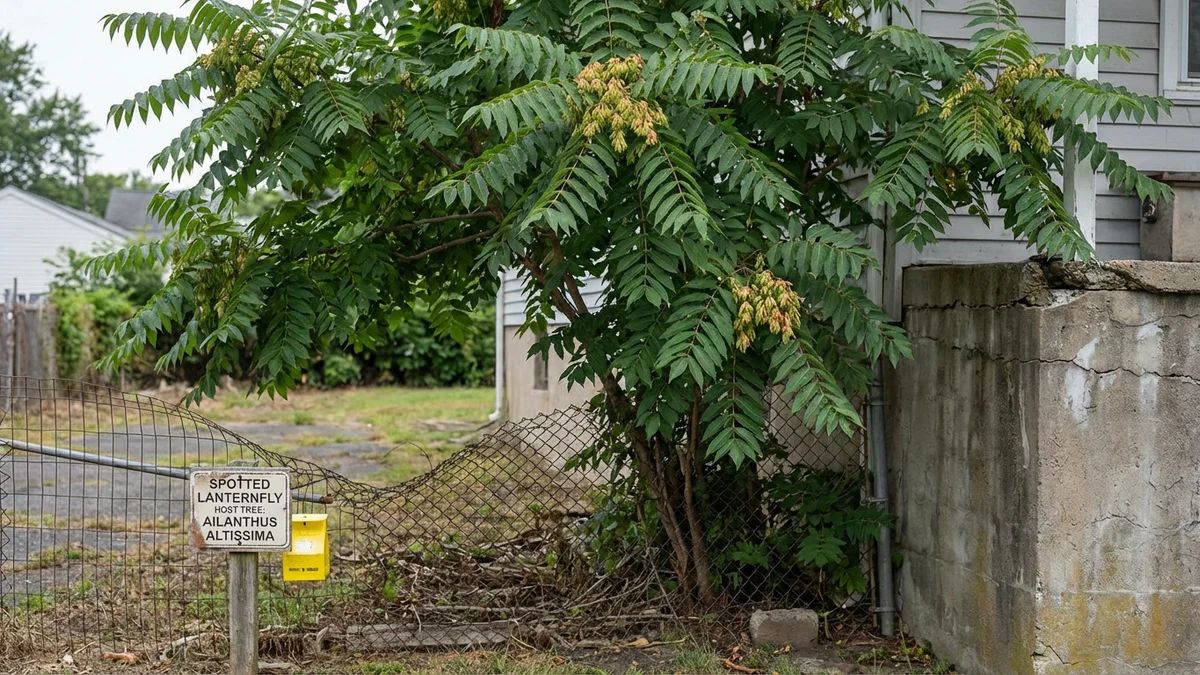
Why tree of heaven matters so much in New Jersey
Tree of heaven shows up well on disturbed ground, property edges, roadsides, and neglected lots. It grows fast, seeds aggressively, and throws up root suckers that let it spread in clusters. A single tree is often not really a single tree in practice. It may be part of a bigger underground system already pushing new shoots into the same area.
New Jersey property owners care about it even more because of spotted lanternfly. State agricultural guidance has repeatedly highlighted tree of heaven as a preferred host for the insect. That does not mean lanternflies only use tree of heaven, but it does mean the tree plays an outsized role in how infestations establish and move around certain properties.
So when owners say they want it gone, they are usually reacting to both problems at once: an invasive tree that spreads aggressively and a pest connection they do not want anywhere near the property.
How to identify it correctly
Good identification matters because tree of heaven gets confused with a few lookalikes. The easiest clues are the large compound leaves, the smooth-edged leaflets, and the small gland-like bumps near the base of each leaflet. When the foliage is crushed, many people notice a strong unpleasant smell. That odor is another clue that you are not looking at a harmless native.
The growth habit matters too. Tree of heaven often appears in clumps or repeated shoots rather than as a neat, isolated ornamental tree. It is common along fence rows, edge habitat, vacant lots, and the backs of commercial or residential parcels where disturbed ground has been left alone.
If the tree is already mixed into thick brush or other invasive growth, it may be harder to spot at first. That is one reason brush clearing and invasive work often overlap on these jobs.
Why cutting it down can make things worse
This is the mistake owners make most often. They see a problem tree, grab a saw, and remove the stem. On many species, that is a reasonable first move. On tree of heaven, it often triggers aggressive regrowth through root suckering. Instead of one obvious problem, you end up with multiple new shoots around the stump and beyond it.
New Jersey agriculture guidance has been clear on this point for years: cutting without the right treatment sequence is not the way to control tree of heaven. In practical terms, that means the removal plan has to deal with the tree’s regrowth response, not just the visible trunk.
That is why tree of heaven removal is not really about felling a tree. It is about breaking the cycle that keeps replacing it.
Where forestry mulching fits
When tree of heaven is part of a larger overgrowth problem, forestry mulching can be a useful mechanical step. It quickly reduces brush, saplings, and invasive clutter so the site becomes accessible again. On properties where tree of heaven seedlings and suckers are scattered through heavier brush, mulching can be a practical way to reset the area.
But just like with other aggressive invasives, mulching alone is not always the final answer. If the root system remains alive and the removal sequence does not account for regrowth, the property may simply produce a new crop of shoots. That is why serious tree of heaven problems are often part of a broader invasive species removal plan rather than a simple knockdown job.
The right sequence depends on the maturity of the trees, the density of the infestation, and what else is happening on the site.
Why edge habitat is where you see it most
Tree of heaven loves the same neglected transition spaces where lots of New Jersey overgrowth problems begin. Fence rows, lot edges, drive approaches, old fill areas, and disturbed woods margins all give it room to establish. Once it gets a foothold, it can climb into a bigger property problem quickly because the seedlings and suckers blend into surrounding brush until they are too numerous to ignore.
That is one reason owners in places like Passaic County and Bergen often first notice it on the perimeter of the property. By the time it stands out, the issue may already involve multiple stems and surrounding brush pressure.
The same pattern shows up on vacant lots and investment properties where maintenance has been inconsistent. Tree of heaven is a classic “this got away from us” plant.
What removal costs depend on
Tree of heaven pricing depends on whether you are dealing with a few stems or a wider colony. The size of the trees matters. So does how much other vegetation is mixed in, whether the site is accessible, and whether the removal needs to be part of a staged regrowth-control plan.
A simple scattered cleanup is different from a property edge where repeated stems are mixed through brush, vines, and volunteer trees. The more the plant has spread through the site, the more the job looks like area-wide invasive management instead of basic tree cutting.
That is why low one-step promises should make owners skeptical. Tree of heaven is a plant that punishes shallow plans.
Why this matters for spotted lanternfly management
Property owners sometimes hope that removing tree of heaven will instantly solve every lanternfly problem. That is not how it works. Spotted lanternfly can use other plants. But tree of heaven removal still matters because it reduces one of the preferred hosts that often concentrates activity and complicates control around a property.
In practical terms, a property edge packed with tree of heaven is bad news whether or not you are seeing lanternflies that day. It gives an aggressive invasive tree more room to spread and keeps a preferred host embedded in the landscape. That is not a good long-term setup.
So even though tree of heaven removal is not a magic pest cure, it is still a very smart land-management move in New Jersey.
The bottom line
Tree of heaven is not a plant to handle casually. It grows fast, spreads aggressively, and often responds badly to simple cut-it-down logic. That is why so many owners think they removed it only to find the property pushing up more shoots a few weeks or months later.
The smarter approach is to identify it correctly, understand the regrowth risk, and use a removal sequence that matches the way the tree actually behaves. On heavily overgrown sites, that often means pairing mechanical clearing with a plan that deals with the root-driven comeback problem instead of pretending it will not happen.
If you have tree of heaven on the property, the goal should not be a quick visual win. The goal should be actual control.
Common Questions
How do I identify tree of heaven?
Tree of heaven has large compound leaves, smooth-edged leaflets with glands near the base, and a strong odor when crushed.
Why is tree of heaven a problem in New Jersey?
It spreads aggressively, throws up root suckers, and is closely associated with spotted lanternfly activity.
Does spotted lanternfly only live on tree of heaven?
No, but tree of heaven is a preferred host and plays an important role in how lanternfly pressure shows up on many properties.
Can I just cut down tree of heaven?
Cutting alone is usually a bad plan because tree of heaven often responds by sending up aggressive root suckers.
Does forestry mulching solve tree of heaven?
Mulching can remove top growth fast, but serious infestations often need a broader control plan because the root system can keep pushing new shoots.
What does tree of heaven smell like?
Many people describe the crushed foliage as having a strong unpleasant odor, which can help with identification.
Why does tree of heaven come back after cutting?
It has a vigorous root system and responds to injury by pushing up new shoots from the base and surrounding roots.
Is tree of heaven common on disturbed ground?
Yes. It often shows up along roadsides, lot edges, neglected properties, and other disturbed areas.
Can you clear tree of heaven around fences and property edges?
Yes. Tree of heaven often appears in the same brushy edges and overgrown lines where other invasive clearing work is already needed.
What is the best first step if I have tree of heaven?
The best first step is accurate identification, then choosing a removal sequence that addresses the regrowth problem instead of making it worse.
Related Services
Invasive Species Removal
Japanese knotweed, multiflora rose, mile-a-minute vine, and other NJ invasives eliminated at ground level.
Forestry Mulching
We grind brush, saplings, and small trees into mulch on the spot – no hauling, no burn piles, no mess.
Brush Clearing
Thick undergrowth, vines, and overgrown fence lines cleared down to clean, walkable ground.
Relevant City Pages
These city pages are a good fit if you want to compare the article advice with the kind of properties we see on the ground.
Related Articles
Forestry Mulching vs. Bulldozing: Which Is Right for Your NJ Property?
Forestry mulching vs. bulldozing for NJ properties: compare cost, speed, soil impact, and when each method makes sense.
See Forestry Mulching vs. Bulldozing: Which Is Right for Your NJ Property?
Land Clearing Cost Per Acre in New Jersey: Pricing Guide
New Jersey land clearing cost per acre explained: method, terrain, tree size, access, and how to compare quotes without getting burned.
See Land Clearing Cost Per Acre in New Jersey: Pricing Guide
Japanese Knotweed Removal in New Jersey: How to Actually Kill It
How to remove Japanese knotweed in New Jersey: identification, why it spreads, why cutting fails, and how mulching plus follow-up treatment works.
See Japanese Knotweed Removal in New Jersey: How to Actually Kill It
Want the full New Jersey land clearing playbook?
This article covers one piece of the puzzle. The complete guide ties together methods, costs, permits, terrain, and contractor selection in one place.
Want Help Sorting Out the Next Step?
If the article answered part of the question but you still need a site-specific answer, send us the address and a few photos.
Or call (908) 774-9235.