

Home / Forestry Mulching / Pohatcong Township, New Jersey
Forestry Mulching in Pohatcong Township, New Jersey
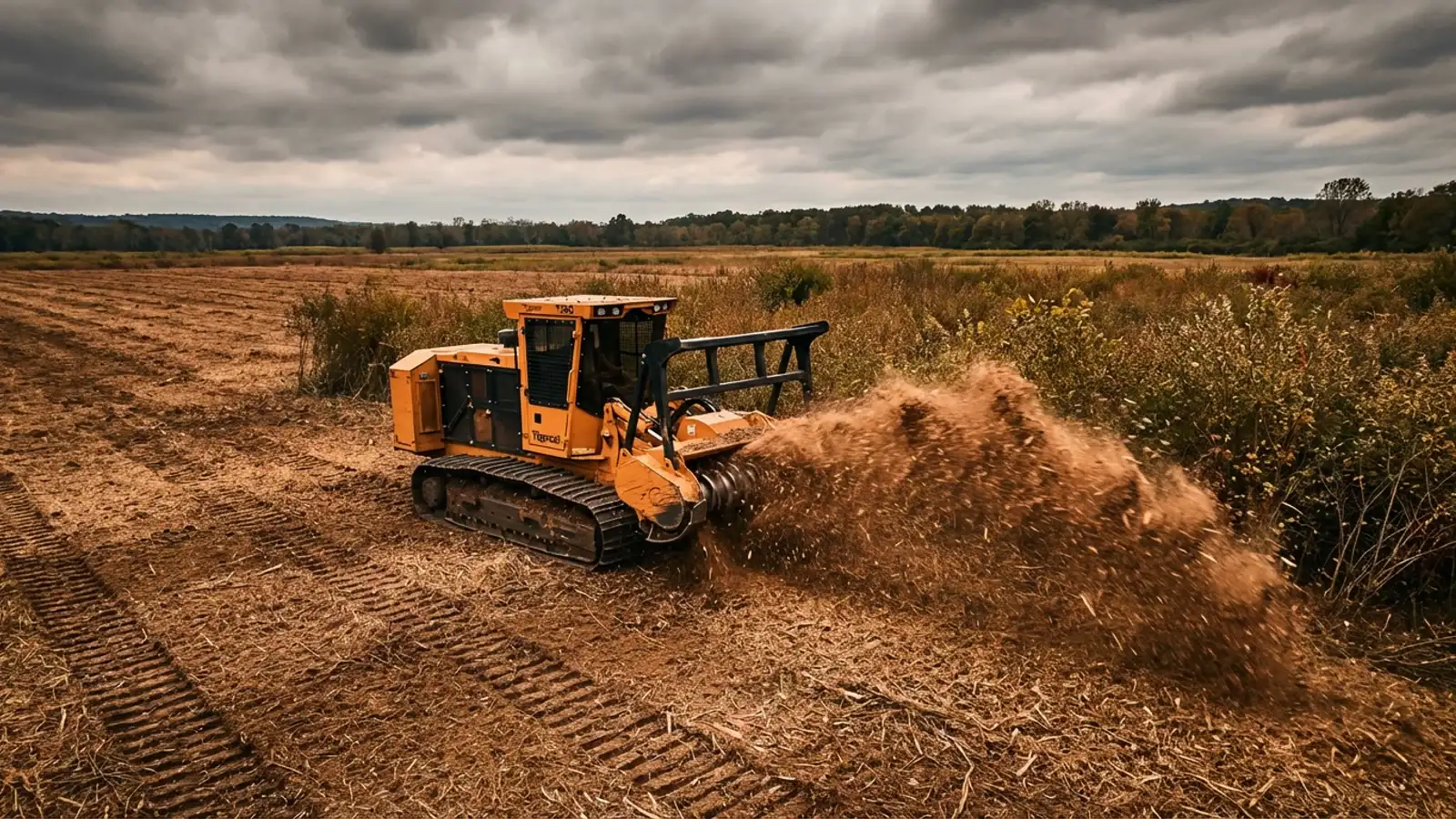
Pohatcong Township is where forestry mulching runs fastest. The Delaware River valley floor that makes up most of the southern half of the township is flat, deep-soiled, and wide open — conditions that let a full-size forestry mulcher work in long, uninterrupted passes at production speed. There are no steep grades to slow the machine, no boulder fields to navigate, and access is typically straight through a farm gate onto open ground. For property owners sitting on five, ten, or twenty acres of fallow farmland choked with autumn olive and multiflora rose, this is the most cost-efficient clearing environment in our entire service area.
Why Forestry Mulching Works in Pohatcong Township
Pohatcong's flat valley-floor terrain is the ideal operating environment for forestry mulching. The machine can run in straight lines across the full width of a field, turning at the edges and making parallel passes — the agricultural equivalent of mowing, but with a cutting head that handles five-inch stems instead of grass. This production-line approach clears acreage fast.
The deep alluvial soils in Pohatcong's valley are another advantage. Unlike the thin, rocky soils in Oxford or the heavy clay on High Bridge's hillsides, the valley floor here has three to five feet of rich, loamy topsoil. The mulch layer from forestry mulching decomposes into this soil readily, adding organic matter and improving the seedbed for whatever comes next — hay, pasture grass, clover, or wildflower meadow.
Bulldozing would work on flat ground but it would strip the topsoil — the most valuable agricultural asset these parcels have. That topsoil took centuries to build through river deposition. Removing it with a dozer blade to clear ten years of brush growth is a bad trade. Forestry mulching takes the brush and adds to the soil instead of removing it.
Brush hogging — the method most farmers try first — works on grass and light brush but fails on Pohatcong's fallow fields once the autumn olive and multiflora rose pass the two-inch stem mark, which happens within about four years of a field going idle. Once those stems hit three to five inches, the bush hog bounces off them or wraps around the shaft. That's when the mulcher becomes the only mechanical option.
What We Typically Mulch in Pohatcong Township
Autumn olive dominates Pohatcong's fallow fields the way it does throughout the Delaware River valley. The silvery-leaved shrubs establish from bird-dropped seeds on every fallow field edge and spread inward. A field abandoned for five years has scattered autumn olive at chest height. A field abandoned for ten has a closed canopy of autumn olive taller than a person, with stems thick enough that you'd need loppers or a chainsaw to get through them by hand.
Tree of heaven is more prevalent in Pohatcong than in most of our service area because of the Route 22 corridor and Alpha's commercial zone. The species thrives in disturbed soil along roads, parking lots, and vacant commercial parcels, then seeds into adjacent agricultural land and residential properties. Removing tree of heaven is both land clearing and spotted lanternfly management — the tree is the insect's primary host, and NJ's agriculture department actively encourages its removal.
Multiflora rose fills every fence line, hedgerow, and field edge. On properties with long boundary lines — common on ten- and twenty-acre parcels — the rose can form continuous thickets four to six feet wide and eight feet tall along the full length of the property.
Along the Musconetcong River corridor on the township's southeastern edge, Japanese knotweed colonizes the riparian zone and pushes into adjacent fields wherever the mowing has lapsed. The knotweed stands are dense and tall — eight to ten feet by midsummer — but they mulch cleanly because the stalks are hollow and the root mass stays below the cutting depth.
Equipment & Approach for Pohatcong Township Terrain
Pohatcong jobs use our full-size forestry mulcher running at maximum production speed. The flat terrain, deep soils, and wide-open access allow the machine to work without the speed restrictions required on rocky or steep-terrain properties. This makes Pohatcong among the lowest per-acre cost areas we serve.
For large field reclamation jobs — five acres or more — the operator makes systematic passes across the width of the field, overlapping each pass slightly to ensure complete coverage. On a clean ten-acre field with moderate autumn olive, the mulcher can process roughly two to three acres per day at full speed.
Fence line work requires a different approach — the operator follows the fence row at slower speed, working three to five feet on each side while navigating around posts and wire. This is more precise work that doesn't benefit from the flat-terrain speed advantage, so fence line pricing is comparable to other areas.
Access in Pohatcong is typically the easiest in our service area. Most agricultural properties have farm gates wide enough for the mulcher to drive through, and many have gravel lanes that run directly to the work area.
Common Questions
How much does forestry mulching cost per acre in Pohatcong Township?
Valley-floor reclamation runs $1,200–$2,200/acre — among the most cost-efficient in our service area. Get a free estimate for your Pohatcong property.
Is forestry mulching faster on flat ground like Pohatcong?
Yes — the mulcher processes 2–3 acres/day on Pohatcong’s flat ground compared to 1–1.5 acres on hilly or rocky terrain.
Can you remove tree of heaven along Route 22 in Pohatcong?
Yes — tree of heaven is a priority removal species along Route 22. We grind above-ground growth. Learn about invasive species removal.
What happens to the mulch on farmland in Pohatcong?
Mulch decomposes in 6–12 months and enriches the topsoil. Seed germinates through the layer for hay or pasture. Learn about pasture reclamation.
Can you mulch along the Musconetcong River in Pohatcong?
The Musconetcong has a 300-foot buffer, but forestry mulching is buffer-compatible — no exposed soil, no sediment. We assess your specific parcel during the site visit.
How quickly can you start a job in Pohatcong Township?
Site visit within a week, start within 2–3 weeks after quoting. For time-sensitive projects, let us know. Schedule a free site visit.
Flat ground. Fast clearing. Fair price.
Pohatcong's valley floor is built for production mulching. Get a free estimate for your property.
Or call (908) 774-9235.