

Home / Field Notes — Land Clearing Knowledge Base / Clearing Land for Outdoor Living Spaces in New Jersey
Clearing Land for Outdoor Living Spaces in New Jersey
Published April 5, 2026 by Brush Busters • Last reviewed April 5, 2026
The backyard patio, fire pit area, and outdoor kitchen you’ve been thinking about all start the same way — with ground you can use. On suburban properties across Somerset and Morris counties, the space where the outdoor living area should go is often the exact area that’s been neglected longest: the rear lot beyond the lawn edge, where a decade of barberry, wild grape, multiflora rose, and sapling regrowth has taken over.
This isn’t a clearing-the-entire-property job. It’s surgical. You’re opening specific zones within the backyard for specific purposes — a level area for the patio, a slightly graded spot for the fire pit, a flat stretch for the outdoor kitchen, a gentle slope for a terraced seating area. The clearing needs to be precise because everything around the cleared zone stays.
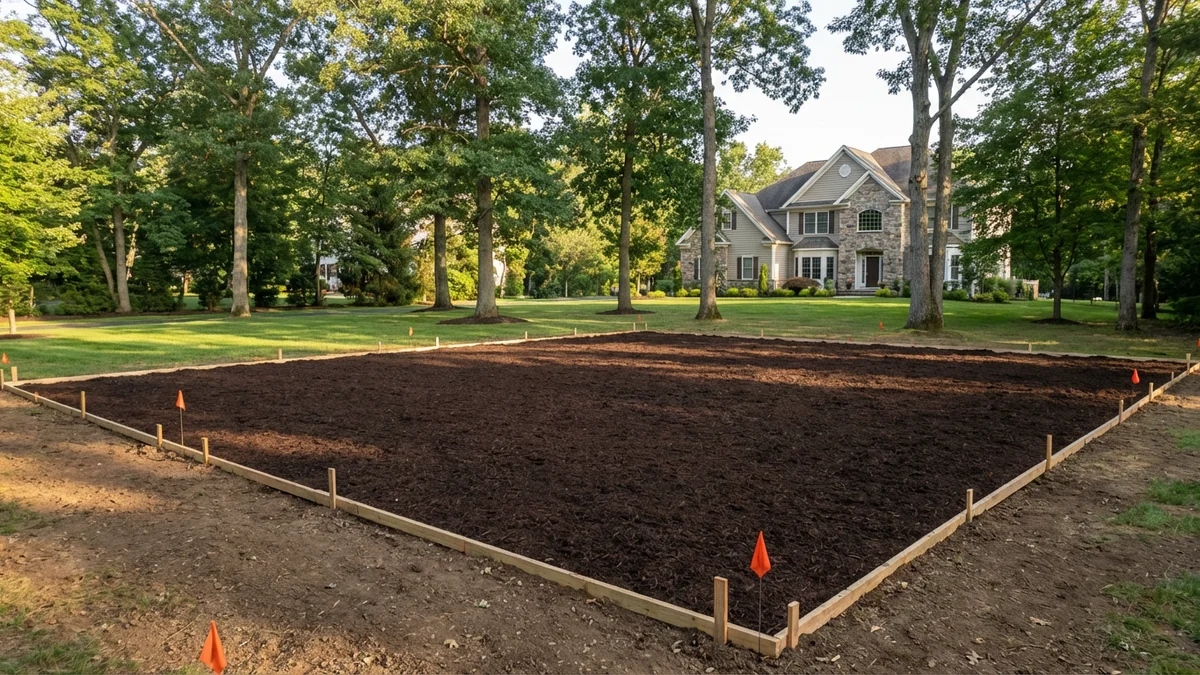
Common outdoor living clearing projects
Patio and hardscape prep. The patio contractor needs a cleared, roughly level area at least 10% larger than the finished patio footprint. This gives room for the base excavation, edge restraints, and grading transitions. On a 400-square-foot patio, clear roughly 500 square feet. Remove all brush, saplings, and roots within that zone. The mulch layer can stay — the patio contractor excavates through it.
Fire pit clearing. A fire pit area needs a minimum 20-foot-diameter cleared zone — the pit itself plus a 10-foot perimeter for seating and fire safety. Many NJ municipalities and fire codes require 10 feet of clear space between an open flame and any combustible material (brush, fencing, structures). Clearing ensures compliance.
Outdoor kitchen and dining area. These need a level cleared area connected to the house by a cleared path. If the outdoor kitchen has a gas line, the gas contractor needs a clear trench run from the house to the kitchen location. The cleared area also needs to accommodate the concrete pad or paver base that supports the kitchen structure.
Terraced seating or hillside viewing area. On sloped properties in the Watchung ridge areas or northern Morris County, carving a usable outdoor space out of a wooded hillside means clearing the understory, selecting which trees to preserve for shade and framing, and creating level platforms where seating or structures will go. Forestry mulching clears the understory while preserving the canopy — the result is a park-like woodland setting rather than a bare slope.
Play areas and recreation zones. Clearing a section of the rear lot for kids’ play equipment, a sport court, or a lawn game area. The mulch layer from clearing actually serves as a temporary play surface while you plan the finished installation — it’s softer than bare soil and free-draining.
The suburban context
Outdoor living clearing happens in suburban neighborhoods, which adds constraints that don’t exist on rural properties:
Neighbors. The clearing crew is working 20–50 feet from the neighbor’s yard. Noise, debris visibility, and equipment access all need to be managed. We give adjacent homeowners a heads-up before the work date.
Access. The equipment needs to get from the street to the rear lot. On many suburban properties in Bridgewater, Hillsborough, and Mendham, the only access is a side yard between the house and the fence — sometimes as narrow as five to six feet. Our compact tracked mulcher fits through four-foot openings. If the access is wider, we bring the full-size machine for faster production.
Existing landscaping. The cleared zone often borders existing lawn, garden beds, ornamental trees, and fencing. Forestry mulching is selective — the operator works right up to the edge of what you’re keeping. We flag the boundary between “clear this” and “preserve this” during the estimate.
Municipal tree ordinances. If the clearing involves removing mature trees — which it might if the outdoor living area requires full sun — check your municipality’s tree ordinance. Brush, saplings, and invasive species removal is typically exempt. Mature tree removal may not be.
Costs for outdoor living site prep
Outdoor living clearing is among the smallest jobs we do — and the most transformative on a per-square-foot basis.
| Project | Typical cleared area | Cost range |
|---|---|---|
| Patio prep (400–600 sq ft zone) | 500–750 sq ft | $800–$1,500 |
| Fire pit clearing (20 ft diameter) | ~315 sq ft | $500–$1,000 |
| Outdoor kitchen area | 300–500 sq ft | $600–$1,200 |
| Full backyard transformation (0.25–0.5 acre) | 0.25–0.5 acre | $1,500–$3,500 |
| Terraced hillside clearing | varies | $2,000–$5,000 |
Most outdoor living clearing jobs take half a day to a full day. The job can often be combined with other backyard work — fence line clearing, invasive removal along the property boundary, opening up the tree canopy for more light — in a single mobilization.
The path from clearing to finished space
Week 0: Clear. We clear the designated zones, preserving flagged trees and existing features. The ground is covered in mulch.
Week 1–2: Design and quotes. With the space visible and walkable, your hardscape contractor, landscape architect, or outdoor kitchen designer can assess the actual conditions — soil, grade, drainage — and give accurate quotes. Many contractors won’t even quote without seeing cleared ground.
Week 2–4: Grading and base work. The hardscape contractor excavates through the mulch layer to establish the sub-base for pavers, concrete, or whatever surface the design calls for. On sloped sites, the grading contractor builds the level pads and retaining walls.
Week 4+: Installation. Pavers, stone, outdoor kitchen components, fire pit materials, lighting, landscaping.
The critical insight: clearing is the unlock. Most people stall on their outdoor living project because they can’t visualize the space through the brush. Once the space is cleared and walkable, every decision becomes concrete rather than hypothetical. The project gains momentum because everyone — you, the designer, the contractor — can see what they’re working with.
Common Questions
How much does it cost to clear a backyard for a patio in NJ?
Patio site clearing costs $800–$1,500 for a typical suburban backyard zone. Most jobs take half a day. Get a free estimate.
Can you clear around existing trees I want to keep for shade?
Yes — we clear the understory while preserving shade and screening trees. We walk the site with you and flag everything that stays.
Will the hardscape contractor have a problem with the mulch?
No — they excavate through it during base prep. The mulch keeps the site stable and clean between clearing and installation.
How far in advance should I clear before installing a patio?
At least 2–3 weeks before the hardscape contractor. There’s no maximum lead time — the mulch protects the site indefinitely.
Can your equipment fit through a suburban side yard?
Our compact mulcher fits through 4-foot openings. We measure during the estimate. Fence sections can be temporarily removed for tighter access.
Do I need a permit to clear my backyard for a patio?
Brush clearing typically needs no permit. The patio itself may need one depending on size and municipality. Check your local building department.
Can you clear on a hillside for a terraced outdoor space?
Yes — our tracked equipment handles slopes up to 45%. We create level zones for retaining walls and platforms. Learn about hillside clearing.
What's the best time of year to clear for an outdoor living project?
Late fall or winter for spring-summer installation. This gives lead time for design and avoids spring scheduling competition. Read our seasonal guide.
Related Services
Brush Clearing
Thick undergrowth, vines, and overgrown fence lines cleared down to clean, walkable ground.
Invasive Species Removal
Japanese knotweed, multiflora rose, mile-a-minute vine, and other NJ invasives eliminated at ground level.
Relevant City Pages
These city pages are a good fit if you want to compare the article advice with the kind of properties we see on the ground.
Helpful Resources
Homeowners
Related Articles
Clearing Land for a Pool in New Jersey
How to clear your backyard for a pool in New Jersey. Tree removal, grading prep, drainage, access for excavators, and what to do before the pool contractor arrives.
How to Clear an Overgrown Backyard in New Jersey
How to clear an overgrown backyard in New Jersey: when DIY works, when it doesn’t, what it costs, and how long it takes.
Want the full New Jersey land clearing playbook?
This article covers one piece of the puzzle. The complete guide ties together methods, costs, permits, terrain, and contractor selection in one place.
See your backyard's potential — not just the brush.
Half a day of clearing opens the space your outdoor living project needs. Free estimates.
Or call (908) 774-9235.