
Home / Field Notes — Land Clearing Knowledge Base / HOA Land Clearing in New Jersey: A Guide for Community Managers and Board Members
HOA Land Clearing in New Jersey: A Guide for Community Managers and Board Members
Published April 7, 2026 by Brush Busters • Last reviewed April 7, 2026
HOA common areas are the most neglected vegetation on any planned development. The wooded buffers between sections, the stream corridors running through the community, the retention basin perimeters, the trail edges, the landscape berms — these are common-area responsibilities that nobody owns personally and HOA budgets rarely prioritize until the board gets enough complaints to act.
By the time the board votes to do something, the buffer zone that was an attractive wooded screen at construction has become an impenetrable tangle of barberry, multiflora rose, and vine growth that harbors ticks, blocks sight lines, and looks terrible. The retention basin perimeter is choked with phragmites. The walking trail has narrowed from eight feet to three.
We clear HOA common areas throughout Bridgewater, Hillsborough, Branchburg, Readington, and the planned communities across our service area. Here’s how to scope, budget, and execute the project with minimal disruption.
Common HOA clearing projects
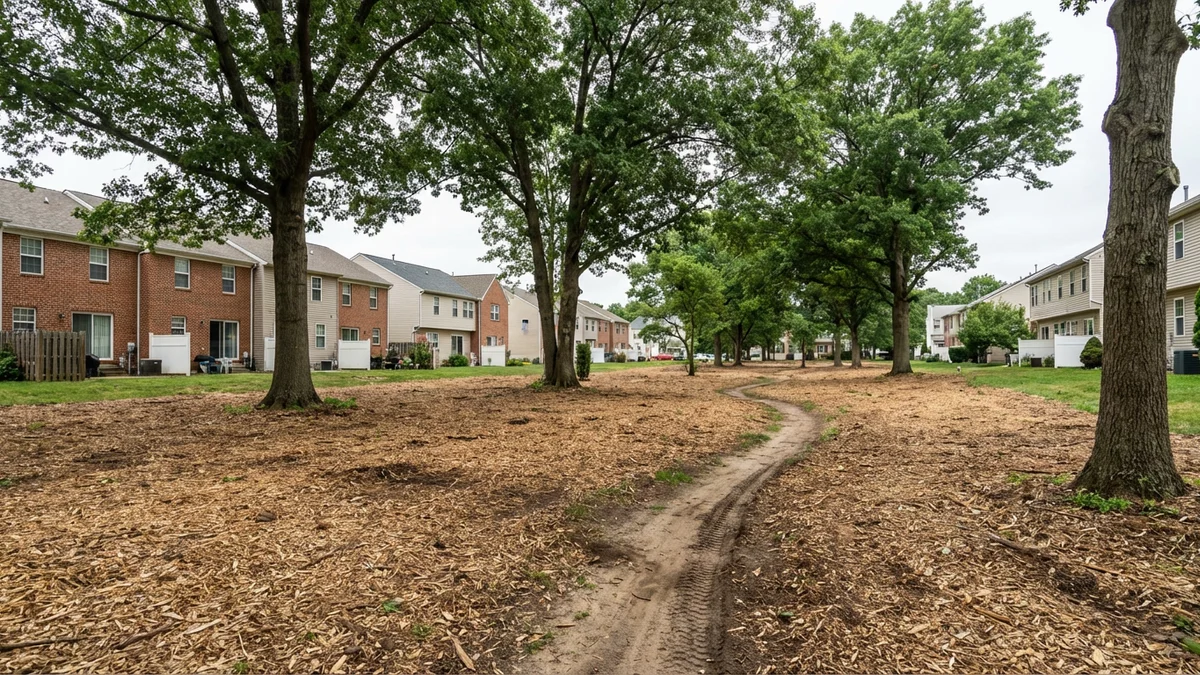
Wooded buffer clearing. The one-to-three-acre wooded strips between townhouse sections, between the community and adjacent properties, or between residential sections and commercial edges. These buffers fill with invasive understory over ten to fifteen years until they’re impassable. Forestry mulching clears the understory while preserving the canopy trees that provide the screening the buffer was designed for.
Stream corridor maintenance. Many NJ planned communities have streams running through them — engineered or natural drainage channels that are common-area responsibility. These corridors accumulate knotweed, phragmites, and dense brush that impedes drainage and creates flood risk. Clearing restores drainage capacity and visibility. Note: stream corridors may have NJ DEP riparian buffer requirements — we assess these during the estimate.
Retention basin perimeters. Stormwater retention and detention basins require periodic vegetation management to maintain capacity and function. Phragmites, cattails, and brush encroachment reduces basin volume and clogs outlet structures. Clearing the perimeter and the basin edges restores function.
Trail and pathway clearing. Walking trails, bike paths, and connector paths through wooded common areas narrow as brush encroaches from both sides. Clearing restores full trail width and improves safety (sight lines, tick reduction, trip hazard elimination).
Landscape berm and entrance clearing. The decorative berms and entrance features that looked polished at community build-out are now overgrown with invasive species and volunteer trees. Clearing restores the designed appearance.
How to scope an HOA clearing project
Walk the common areas with the management company or board representative. Identify every area that needs clearing — don’t assume the board knows the full extent. Most boards underestimate the scope because nobody has walked the back buffer in years.
Prioritize by impact and visibility. If the budget can’t cover everything at once, clear the highest-visibility and highest-impact areas first: entrance features, the buffer behind the most complaints, and any area with a safety issue (tick habitat near playgrounds, drainage obstruction causing flooding, dead trees near walkways).
Get a single comprehensive quote. A single mobilization covering all common areas in one project is dramatically more cost-effective than multiple small trips. The equipment setup and transport cost is the same whether we clear one buffer or five. Consolidating the work into one project can cut the per-area cost by 30–40%.
Budget annually. HOA common area vegetation grows back. An annual maintenance mow of previously cleared areas costs a fraction of the original clearing. Building an annual vegetation management line item into the HOA budget prevents the cycle of neglect → complaints → expensive clearing → neglect.
Scheduling around residents
The biggest concern for HOA boards is resident disruption. Here’s how we handle it:
Timing. We recommend clearing during the work week (Monday–Friday) when most residents are at work. Avoid weekends and holidays. October through February is ideal — less foot traffic on trails, fewer outdoor activities, and the clearing conditions are best.
Communication. The board or management company should notify residents at least one week before clearing begins. A simple notice: “Common area vegetation maintenance is scheduled for [dates]. Please keep children and pets away from the work area. The walking trail through [section] will be temporarily closed.” We can provide template language.
Noise. The forestry mulcher is loud — comparable to a large wood chipper. Residents in units adjacent to the clearing area will hear it. A heads-up in the notice helps set expectations. Most clearing work runs 7 AM to 4 PM.
Trail closures. If the clearing involves a walking trail or common pathway, close that section during clearing and reopen when complete. On multi-day projects, we clear in sections so the entire trail isn’t closed simultaneously.
Parking and access. The equipment arrives on a trailer and needs a staging area near the work zone. We coordinate with the management company on where to park and how to route equipment through the community without blocking resident access.
Costs for HOA clearing
| Common area type | Typical size | Cost range |
|---|---|---|
| Wooded buffer (understory clearing) | 1–3 acres | $3,000–$10,000 |
| Stream corridor | 500–2,000 linear ft | $2,000–$6,000 |
| Retention basin perimeter | varies | $1,500–$4,000 |
| Trail widening/restoration | 1,000–3,000 linear ft | $1,500–$5,000 |
| Entrance/berm clearing | varies | $800–$2,500 |
| Comprehensive (all common areas) | varies | $8,000–$25,000 |
Annual maintenance after the initial clearing: $2,000–$5,000 for a full community pass. This is the number that belongs in the annual HOA budget.
Common Questions
How much does HOA common area clearing cost?
Comprehensive clearing: $8,000–$25,000. Individual areas: $1,500–$10,000. Annual maintenance: $2,000–$5,000. Request an HOA clearing quote.
Can you clear without removing the canopy trees in the buffer?
Yes — we clear the invasive understory while preserving all canopy trees. The result is a park-like buffer that screens and is walkable. Learn about invasive understory removal.
How do you minimize disruption to residents?
Weekday scheduling, coordinated access, advance resident notice, sectional trail closures, and efficient execution. We’ve done this across multiple NJ communities.
Do HOA common areas have environmental restrictions?
Stream corridors may have riparian buffers. Basins may have stormwater rules. Buffers may have development-approval conditions. We check during the estimate.
Should we clear everything at once or in phases?
One comprehensive project is 30–40% cheaper than phased work. If budget requires phasing, prioritize by visibility, safety, and drainage function.
How often does cleared common area need maintenance?
Annual mowing — one pass per year, typically late fall. Without it, expect reversion in 3–5 years. Build it into the annual HOA budget.
Can you clear around a playground or pool area?
Yes — we schedule off-peak and cordon the area during clearing. October–March avoids pool and playground season conflicts.
Do you handle the board presentation?
We provide a board-ready written proposal with scope, pricing, timeline, and a clearing area map. We can attend a board meeting to present if requested.
Relevant City Pages
These city pages are a good fit if you want to compare the article advice with the kind of properties we see on the ground.
Want the full New Jersey land clearing playbook?
This article covers one piece of the puzzle. The complete guide ties together methods, costs, permits, terrain, and contractor selection in one place.
HOA common areas don't maintain themselves.
One comprehensive clearing project. One annual maintenance pass. We provide board-ready proposals.
Or call (908) 774-9235.