

Home / Forestry Mulching / Lebanon Township, New Jersey
Forestry Mulching in Lebanon Township, New Jersey
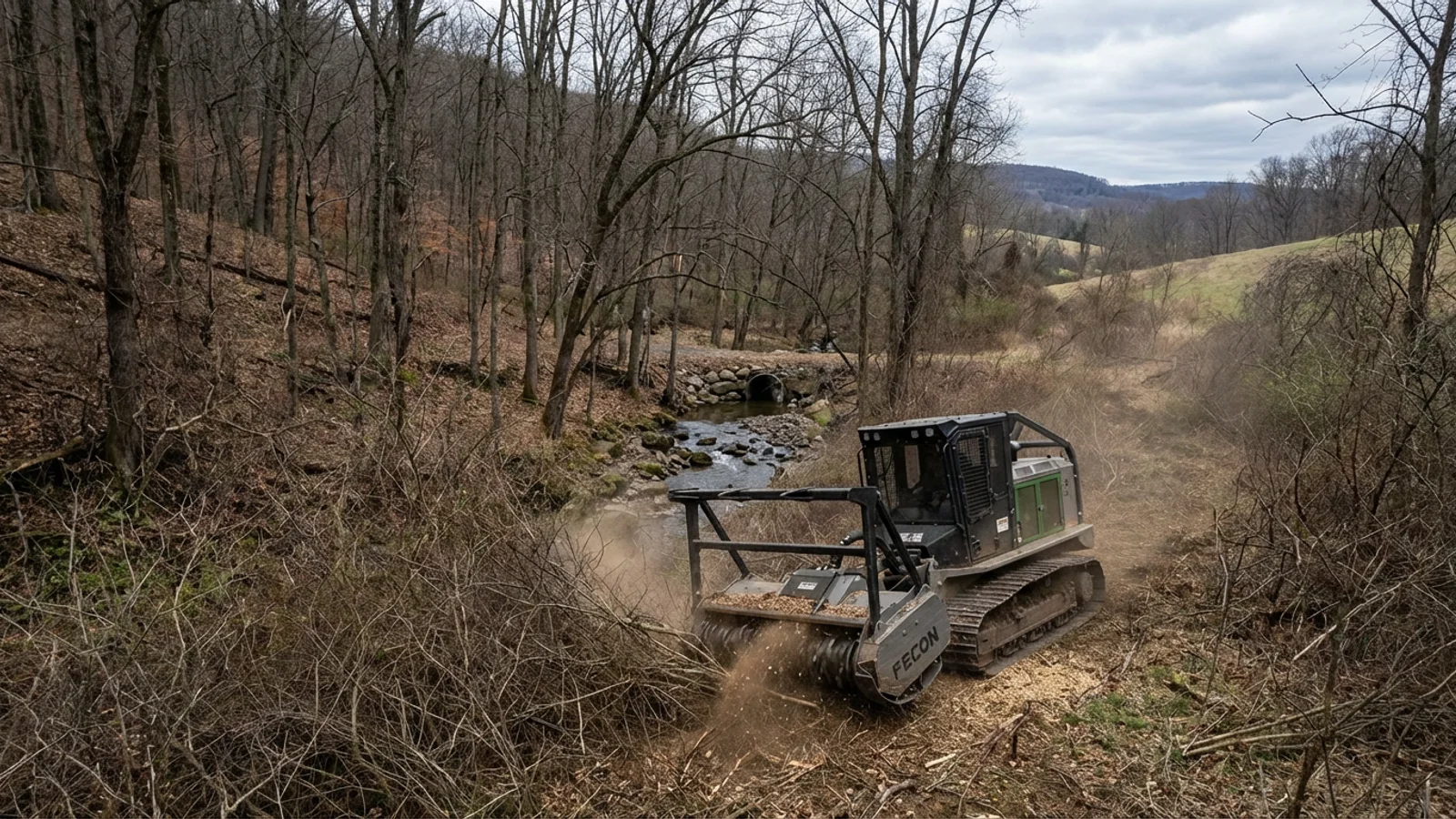
Lebanon Township is the kind of terrain forestry mulching equipment was designed for — steep ridges, rocky soil, dense brush, and properties big enough that any method slower than a mulcher would take weeks and cost a fortune. A twenty-acre wooded parcel with ten years of unchecked growth isn't a job for a chainsaw crew. It's not a job for a bulldozer on rocky slopes where the topsoil is six inches deep. It's a job for a tracked mulcher that grinds through everything at ground level, handles the grades, rolls over the rock outcrops, and leaves the soil intact underneath. We work Lebanon Township regularly because the terrain demands this specific tool.
Why Forestry Mulching Works in Lebanon Township
The rocky terrain is the first reason. Lebanon Township's shale-derived soils are thin, and exposed rock outcrops appear on slopes across the township. A bulldozer on this ground would catch blade edges on rock, strip the thin topsoil layer permanently, and leave scarred ground that will never recover without imported fill. Forestry mulching passes over rock outcrops without damage — the mulcher head floats above the surface and processes vegetation at whatever height the ground presents. The thin topsoil stays in place, the rock stays where it is, and the mulch blanket settles between them.
The scale is the second reason. Lebanon Township properties are large. A five-acre food plot clearing, a half-mile access trail, a ten-acre parcel reclamation — these aren't backyard projects. The forestry mulcher's production rate of one to three acres per day makes these projects feasible at costs that don't require a second mortgage. Hand clearing the same work would take weeks and cost three to five times more.
For hunting land specifically, forestry mulching creates the kind of habitat features that improve deer and turkey hunting. Food plots cleared by mulching have a nutrient-rich mulch base that holds moisture during germination. Shooting lanes cut through dense brush create defined sight lines without removing the surrounding cover that deer use for travel. Edge habitat — the transition zone between dense cover and open ground that deer prefer — is maximized when you clear selectively rather than leveling everything.
What We Typically Mulch in Lebanon Township
The vegetation in Lebanon Township tells a story of succession. Properties neglected for three to five years have goldenrod, autumn olive, and red cedar. Five to ten years produces dense sapling stands of red maple, sweetgum, black cherry, and ash, with multiflora rose filling every gap. Properties left for fifteen or more years have closed-canopy young forest with trees approaching eight to ten inches — at the upper limit of what a forestry mulcher handles in a single pass.
Multiflora rose is the constant understory invasive across all stages of succession. It colonizes fence rows, trail edges, logging roads, and any gap in the canopy. On properties where the woods are mature enough to have a closed canopy, the rose concentrates along the edges and in any opening where a tree fell.
Autumn olive dominates the open-field succession — it's the first woody colonizer on former agricultural ground and spreads so aggressively that a field can go from scattered seedlings to impenetrable thicket in four to five years. On the drier ridgetops, red cedar competes with autumn olive for the same abandoned fields and wins on the rockier, thinner soils.
Along the Musconetcong corridor and the streams feeding Spruce Run, Japanese knotweed holds the streambanks. Virginia creeper and wild grape vine through the canopy in the lowland areas. On the steep north-facing slopes, barberry fills the understory wherever enough moisture accumulates.
Equipment and Approach for Lebanon Township Terrain
Full-size tracked forestry mulcher is the standard machine for Lebanon Township. The lots are big enough to justify it, and the terrain demands the stability that tracks provide on rocky, sloped ground. The operator adjusts the mulcher head height constantly to ride over rock outcrops, surface roots, and the uneven ground that characterizes every ridge and slope in the township.
On the steepest sections — particularly the ridges north of Spruce Run and along the Musconetcong corridor — the operator works across the slope and avoids working directly up or down. On grades that approach the conventional machine's limits, we evaluate whether a remote-controlled mulching unit is appropriate.
For food plot clearing, the approach is different from full-parcel work. The operator clears a defined opening to a specific size and shape, often leaving standing trees along the edges to create the transition zone between cover and open ground that deer prefer. Stumps are ground flush with the surface so the plot can be disked and seeded. Shooting lanes radiate outward from stand positions and are cleared to specific widths — usually six to eight feet — to create sight lines without over-exposing the area.
Access road clearing on undeveloped parcels is often the first task on a Lebanon Township project. The equipment can't reach the interior work area without a cleared path from the township road. We cut the access road first, then use it for equipment movement throughout the rest of the project.
Common Questions
How much does forestry mulching cost in Lebanon Township, NJ?
Mulching ranges from $2,500 for a food plot to $12,000+ for large parcels. Rocky terrain increases per-acre costs. Get a free estimate.
Can forestry mulching handle the rocky ground in Lebanon Township?
Yes. The mulcher rides over rock outcrops without damage. This is the primary reason mulching is preferred on Lebanon Township’s rocky terrain — it works with the ground rather than fighting it.
How do you create food plots with forestry mulching?
We clear an opening, grind stumps flush, and leave mulch that retains moisture and suppresses weeds. We shape plots for edge habitat and cut shooting lanes. Learn about our hunting land services.
How long does it take to clear a large parcel in Lebanon Township?
Five acres takes three to four days. Ten acres takes five to seven days. Rocky or steep terrain extends timelines. We provide detailed estimates with every quote.
Will forestry mulching work on the slopes above Spruce Run?
Yes. Our tracked equipment handles slopes above Spruce Run. The mulch layer is critical — it prevents erosion on these rocky hillsides. Learn about our hillside clearing service.
Can you clear an access road to my undeveloped parcel in Lebanon Township?
Yes. We clear 12–16 foot access roads that are immediately drivable. The mulch surface serves as a base for gravel. Learn about our right-of-way clearing service.
Twenty acres of brush between you and your plans? We can fix that.
Get a free estimate — food plots, building sites, trail systems, full clearing. Tell us what you need.
Or call (908) 774-9235.