

Home / Forestry Mulching / Mansfield Township, New Jersey
Forestry Mulching in Mansfield Township, New Jersey
Mansfield is where forestry mulching works at its simplest and most efficient. Flat-to-rolling terrain. Deep, forgiving soils. Wide-open parcels with good road access. No Highlands restrictions. No municipal tree ordinance. And more idle agricultural land than any other township in our service area. A full-size tracked mulcher runs long, uninterrupted passes across twenty-acre fields of autumn olive and cedar, processing two to three acres a day and leaving clean, topsoil-intact ground that's ready for reseeding. There's no method that comes close to matching this speed and result on Mansfield's scale.
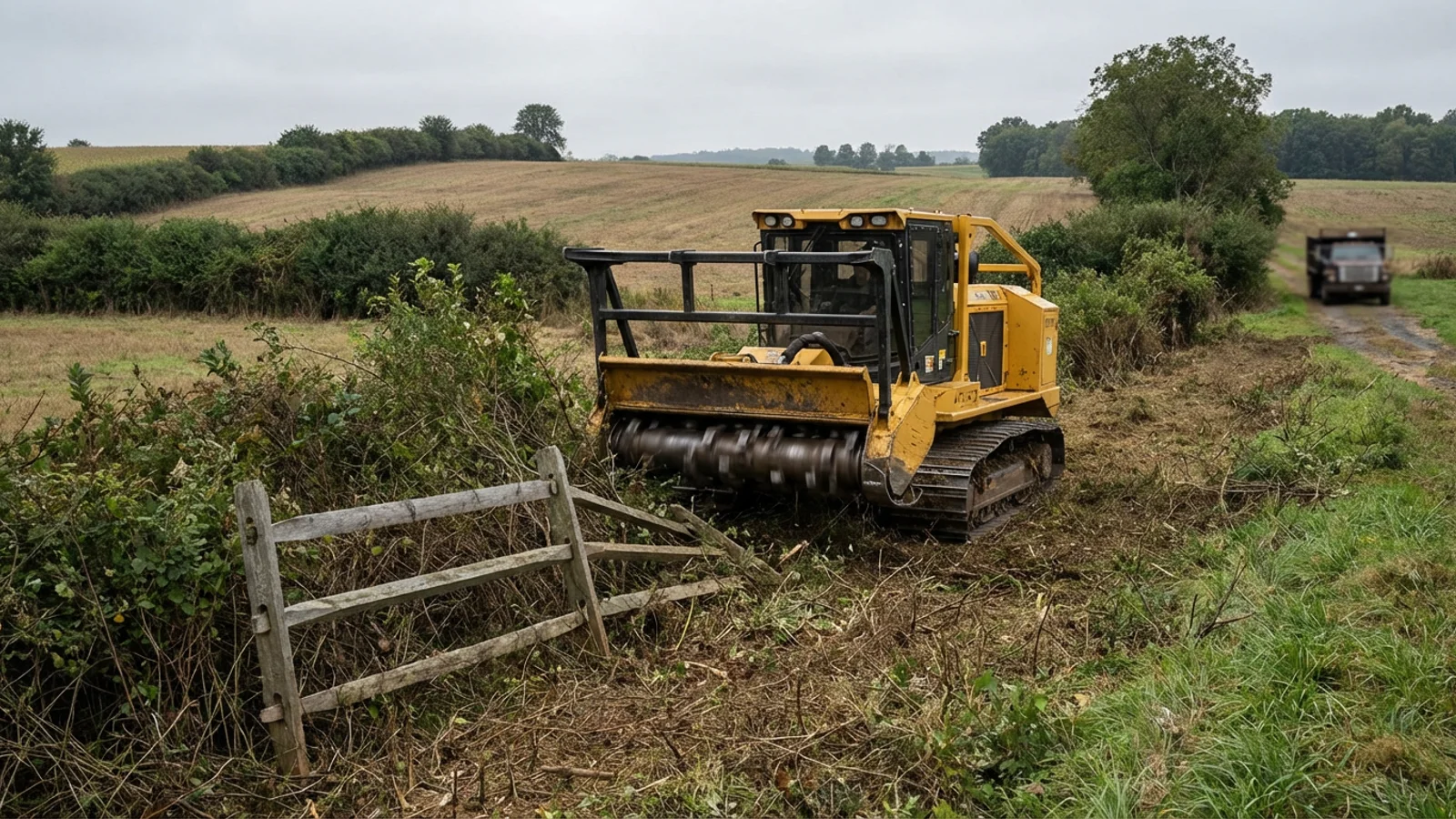
Why Forestry Mulching Works in Mansfield
Mansfield's terrain eliminates every obstacle that slows forestry mulching in other townships. The slopes are mild — no mountain grades, no rocky outcrops, no terrain breaks that force the operator to reposition. The soils are deep enough that the equipment doesn't hit rock. The parcels are large and open enough that the mulcher runs in consistent, long passes without stopping to navigate around structures, fences, or property-line obstacles. Production rate in Mansfield peaks higher than anywhere else in our service area because nothing slows the machine down.
The absence of Highlands restrictions removes the regulatory overhead. In townships like Lebanon or Washington (Morris), a property owner may need to determine whether their parcel is in the Preservation Area, file for a Highlands Applicability Determination, or wait for DEP review before clearing. In Mansfield, the process is: call, quote, schedule, clear. The land gets back into use weeks or months sooner.
For agricultural reclamation specifically, forestry mulching's soil preservation is the deciding factor. Mansfield's deep silt-loam soils are the agricultural asset. A bulldozer would compact and strip them. Mulching preserves them. And the decomposed mulch enriches them. It's the only clearing method that leaves the soil better than it found it.
What We Typically Mulch in Mansfield
Autumn olive, at scale. Some Mansfield fields have been idle long enough that the autumn olive has formed a continuous canopy — not individual shrubs but a solid wall of vegetation eight to fifteen feet tall stretching across entire fields. The mulcher enters at one edge and works systematically across, row by row, processing the entire field. On fields this dense, the mulch layer afterward is thick — four to six inches — which takes longer to decompose but provides excellent weed suppression during the transition back to agriculture.
Multiflora rose fills the hedgerows and field margins. On Mansfield's large farms, a single hedgerow can run two thousand feet or more. The rose has expanded these hedgerows from narrow boundaries into wide thickets that consume productive acreage on both sides. We clear them back to a defined edge, recovering field area with every pass.
Virginia pine and red cedar on the drier hilltops form dense evergreen stands that feel permanent but mulch quickly. Cedar's shallow root system and soft wood make it one of the easiest species to process. A field of chest-high cedar that looks hopeless is open ground in a few hours.
Phragmites fills the wet bottomlands along the Musconetcong and the interior drainage channels. It grows dense enough to completely block visibility from the road. Mulching removes the standing stalks but the root system regenerates aggressively — herbicide follow-up is essential for lasting control.
Equipment and Approach for Mansfield Terrain
Full-size tracked forestry mulcher is the only machine we bring to Mansfield. The parcels are too large for anything smaller to be productive. The operator runs the machine in systematic parallel passes across the field, processing everything in overlapping rows. On a twenty-acre field, this pattern produces uniform clearing with consistent mulch depth across the entire area.
The gentle terrain means the operator can maintain a consistent forward speed throughout the pass — no slowing for slopes, no repositioning around obstacles, no working across uneven ground. This maximizes production and minimizes the per-acre cost.
For hedgerow clearing, the operator approaches from the field side and processes inward, reducing the hedgerow to the desired width. On long hedgerows running a thousand feet or more, the operator makes a single continuous pass along the full length.
On bottomland projects near the Musconetcong, the operator stays on firm ground and works the edges of the wet areas rather than driving into soft soils. On particularly wet sites, we schedule the work for dry conditions or wait for a hard winter freeze that firms the ground enough to support the machine.
Common Questions
How much does forestry mulching cost per acre in Mansfield, NJ?
Mulching runs $1,800 to $3,500 per acre. Mansfield’s terrain makes it one of the most cost-efficient areas we work. Get a free estimate.
How many acres can you mulch in a day in Mansfield?
Two to three acres per day in moderate brush. Light growth goes faster. These are our highest production rates because the terrain is ideal.
What should I plant after forestry mulching in Mansfield?
Hay mix, pasture grass, native meadow, or food plot — depends on your goals. We advise on timing and approach during the site visit. Learn about our reclamation process.
Will autumn olive grow back after mulching in Mansfield?
Mulching kills the majority by grinding the root crown. Spot herbicide on resprouts finishes the job. Regular mowing prevents reestablishment.
Do you need special permits to clear farmland in Mansfield?
Usually no. Mansfield is outside the Highlands with no tree ordinance. Riparian buffers apply near the Musconetcong. See our NJ permits guide.
Can you clear during winter in Mansfield?
Winter is excellent — firm ground, dormant vegetation, better visibility. Heavy snow can slow access, but we work through most winters without interruption. Read our seasonal clearing guide.
Mansfield farmland clears fast and costs less per acre than anywhere else.
Get a free estimate and find out how quickly we can get your fields back into production.
Or call (908) 774-9235.